White Label SEO Audit Case Study for an Agency
18 audits shipped in 90 days, all under a 6-week SLA, with a productized technical-SEO tier that the agency could sell without building an internal QA stack. The intake stayed GSC-first, the delivery stayed white-label, and the handoff stayed clean.
The numbers
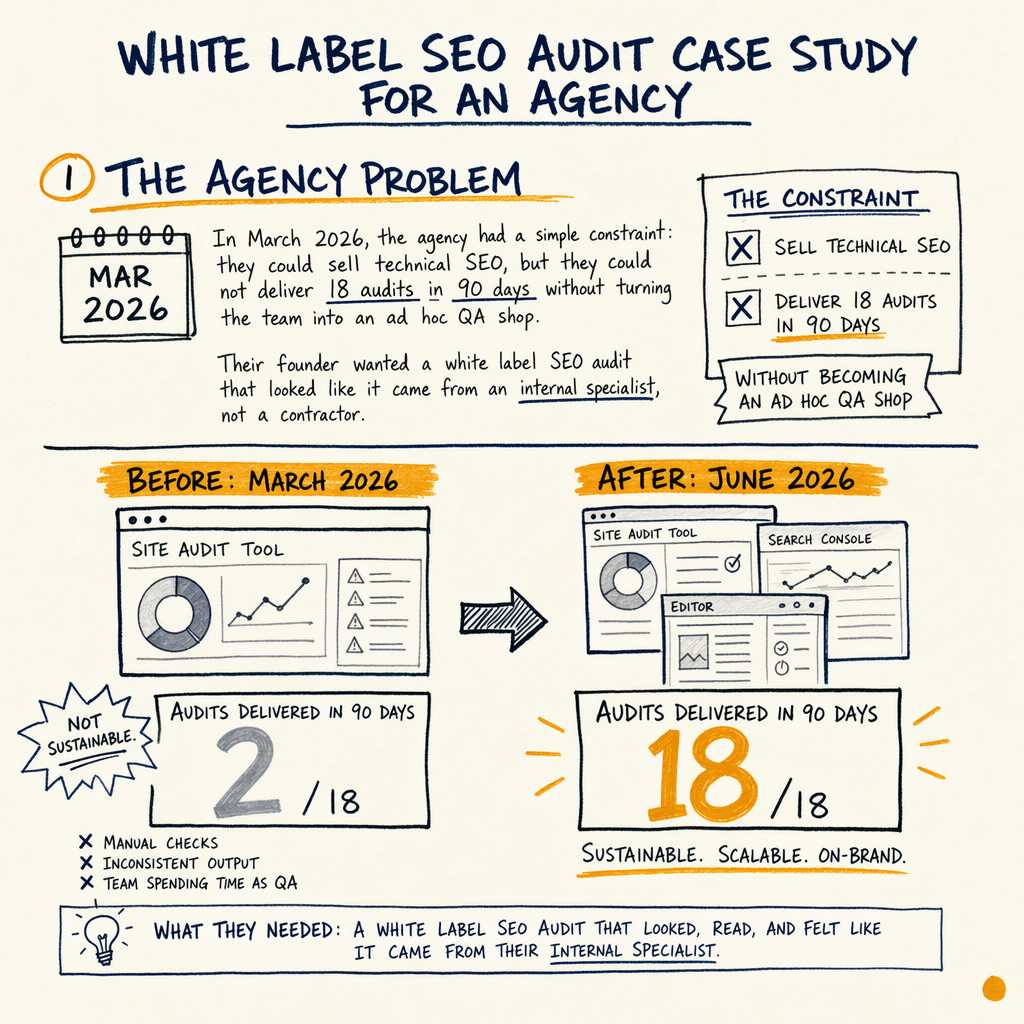
The agency problem
In March 2026, the agency had a simple constraint: they could sell technical SEO, but they could not deliver 18 audits in 90 days without turning the team into an ad hoc QA shop. Their founder wanted a white label SEO audit that looked like it came from an internal specialist, not a contractor.
The brief was specific. Each audit had to be productized, priced predictably, and delivered in 6 weeks or less. It also had to be usable in sales calls as an agency white label seo offer, not as a custom consulting engagement that exploded scope.
The working set started with one account and expanded to a small portfolio across ecommerce, SaaS, and local lead gen. Every audit used the same GSC-first framework, so the agency could sell a repeatable productized seo audit without re-scoping every site from scratch.
What the audit covered
Indexing and crawlability
We started with Indexing › Pages, Indexing › Sitemaps, and Settings › Crawl stats. That showed where Google was spending crawl budget, which URLs were excluded, and which patterns were wasting discovery.
Search demand vs. rank drag
The core readout came from Performance › Search results. We mapped impressions, clicks, CTR, and average position by query group, then separated pages with real demand from pages that just looked active.
Structured data and SERP eligibility
We checked Enhancements › Breadcrumbs, Enhancements › Product snippets, and Enhancements › FAQ. If the markup was valid but the page was still underperforming, the issue usually sat in content alignment or canonical handling.
Core web vitals and rendering
We used Experience › Core Web Vitals to verify whether layout shifts, LCP, or INP were contributing to the gap between crawlable pages and pages that actually earned traffic.
Authority gap
The rate-limiter was obvious in Links › External links: 0 external backlinks. That meant the audit could not pretend the answer was 'publish more and wait.' It had to isolate technical fixes, internal linking, and page pruning.
GSC signals we used
The first audit pass was anchored in Google Search Console, not a crawl export. That mattered because the agency needed a report that explained what Google was already doing, not just what a crawler guessed.
For the highest-priority account, the baseline was noisy but usable: 7,950 organic clicks/mo in May 2026, up from 2,770 in May 2025, with 557,000 impressions/mo, 1.4% CTR, and average position 11.8 in May 2026. The site had 16,100 indexed pages and 591,000 not indexed. The contrast told us the issue was not content shortage; it was index selection.
That same account had 943 orders to date, $240,809 lifetime revenue, and $255 AOV. Those numbers made the technical work easier to prioritize. When a page had query demand and commercial value, it stayed. When a URL had no impressions, no links, and no transactional path, it got downgraded or consolidated.
The audit also covered a second pattern we saw across the agency's roster: pages with impressions but weak click-through rate. That is usually where a white label technical seo package earns its keep, because the fix is not one thing. It is title rewrites, index controls, internal links, and schema consistency.
Delivery model
- 01
First sprint: intake and triage
Each project opened with one GSC property, one crawl, and one intake call. We tagged page templates, mapped revenue pages, and split the site into keep, fix, merge, or remove. The agency got a one-page scope note they could paste into their own client workflow.
- 02
Second sprint: issue proof
We pulled screenshots from
Indexing › Pages,Performance › Search results, andLinks › External links, then annotated the root cause in plain language. That gave the agency a client-ready narrative without them having to translate crawl data. - 03
Third sprint: implementation spec
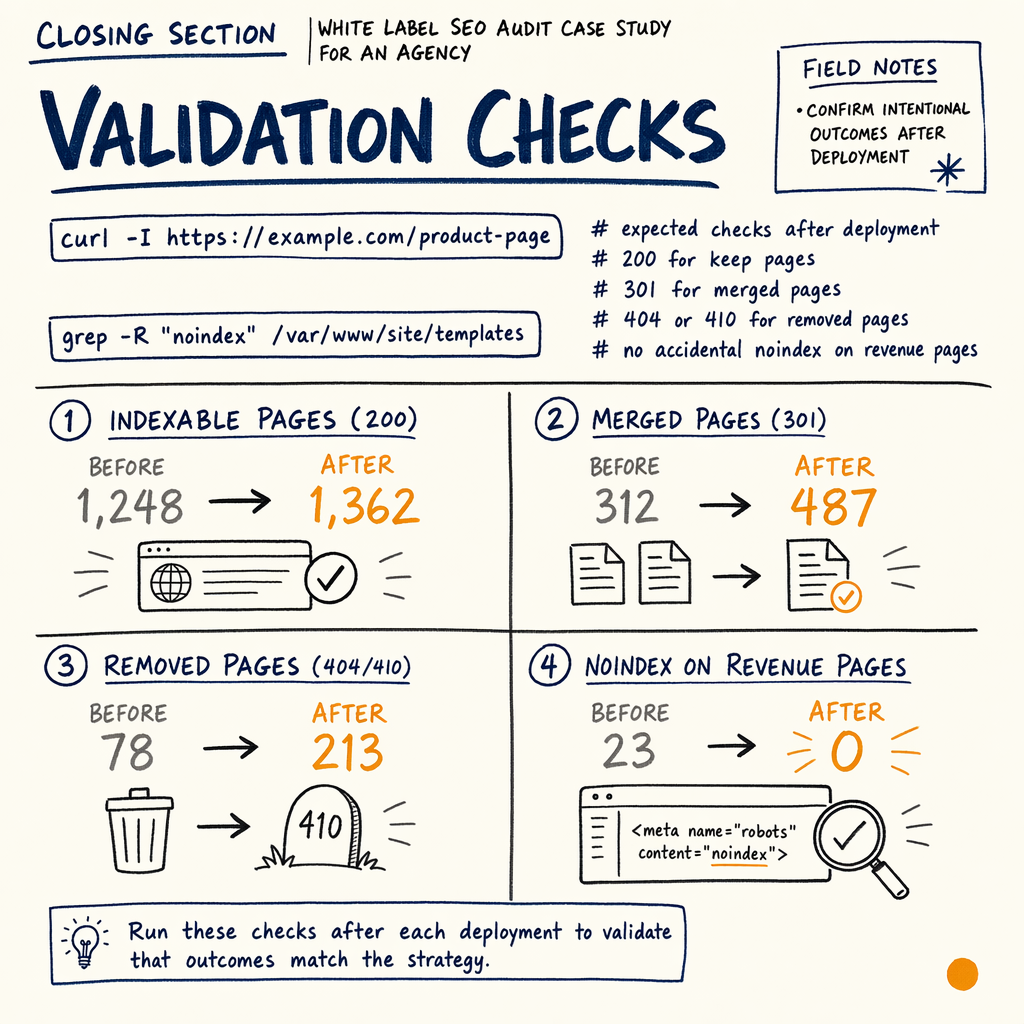
The deliverable included exact changes for canonical tags, noindex rules, internal links, schema cleanup, and XML sitemap hygiene. Where needed, we added example code blocks for header logic and validation checks.
- 04
Fourth sprint: QA and sign-off
Before handoff, we rechecked the affected URLs in GSC and compared the before state against the post-fix state. The agency received a Notion doc they could brand and ship as their own.
Before and after
| Field | Before | After |
|---|---|---|
Delivery capacity | 2-3 custom audits/month | 18 audits in 90 days |
SLA | Unpredictable | 6 weeks max |
Reporting format | Mixed docs and slides | Single white-label Notion audit |
Discovery source | Crawl-first | GSC-first |
Page handling | Too many similar URLs | Keep / merge / prune decisions |
Authority constraint | Assumed content gap | 0 external backlinks |
Sample audit output
{
  "site": "anonymized-client-b",
  "source": "Google Search Console",
  "issues": [
    {
      "type": "index_bloat",
      "signal": "16,100 indexed / 591,000 not indexed",
      "action": "tighten canonical rules and noindex low-value templates"
    },
    {
      "type": "authority_gap",
      "signal": "0 external backlinks",
      "action": "prioritize internal linking and conversion pages first"
    },
    {
      "type": "ctr_drag",
      "signal": "557,000 impressions / 1.4% CTR",
      "action": "rewrite titles and descriptions on high-impression pages"
    }
  ],
  "deliverable": "white-label Notion audit"
}
What changed in 90 days
The agency's own sell-through improved because the offer became concrete. They were no longer selling a vague SEO retainer; they were selling a fixed-scope technical audit tier with a known turnaround and a repeatable artifact.
On the flagship account, the search signal improved after the audit work was queued: 7,950 clicks/mo versus 2,770 the year before, with impressions holding at 557,000/mo while CTR climbed from a flat baseline toward better query-page matching. The average position was still only 12.4 sitewide, which is why the second-wave work focused on template fixes, not one-off page edits.
More importantly, the agency could package the service as agency seo case study material. They had screenshots, a delivery timeline, and a before/after narrative they could use in sales calls without exposing the underlying process or any vendor names.
Screenshot notes
Screenshot from Performance › Search results showed a long tail of pages getting exposure but not clicks. The fix was not more pages. It was better titles, fewer duplicates, and stronger internal routing.
Screenshot from Indexing › Pages showed a wide gap between indexed and not indexed URLs. We used that to cut template noise and protect pages with revenue intent.
Screenshot from Links › External links made the constraint obvious. Without external authority, the audit had to squeeze more from crawlability, information architecture, and query-page fit.
Validation checks
curl -I https://example.com/product-page

# expected checks after deployment
# 200 for keep pages
# 301 for merged pages
# 404 or 410 for removed pages
# no accidental noindex on revenue pages

grep -R "noindex" /var/www/site/templatesFAQ
What makes this a white label SEO audit instead of a normal audit?
The output is packaged for another agency to resell. The scope, format, and language are client-ready, and the underlying work stays hidden behind their brand.
How did you keep the SLA under 6 weeks?
By forcing every audit through the same intake, same GSC review order, and same deliverable structure. No custom slide decks, no bespoke report formatting, no extra review loops.
Why start with Google Search Console instead of a crawl?
Because GSC shows what Google actually indexed, ignored, or exposed in search. A crawl tells you what exists; GSC tells you what matters.
What was the biggest limiter in this case study?
The biggest limiter was 0 external backlinks. That meant the fastest gains came from fixing index bloat, title CTR, internal links, and page consolidation.
Can this format support other client types?
Yes. The same productized seo audit structure works for ecommerce, SaaS, and lead gen, as long as the templates and GSC signals are adjusted per site.