Hreflang implementation for multi-language SEO
**557,000 impressions a month can still split across the wrong locale if your hreflang set is incomplete.** On enzymes.bio, 35 languages, 16,100 indexed pages, and 0 external backlinks made precision more important than brute force.
Why hreflang matters
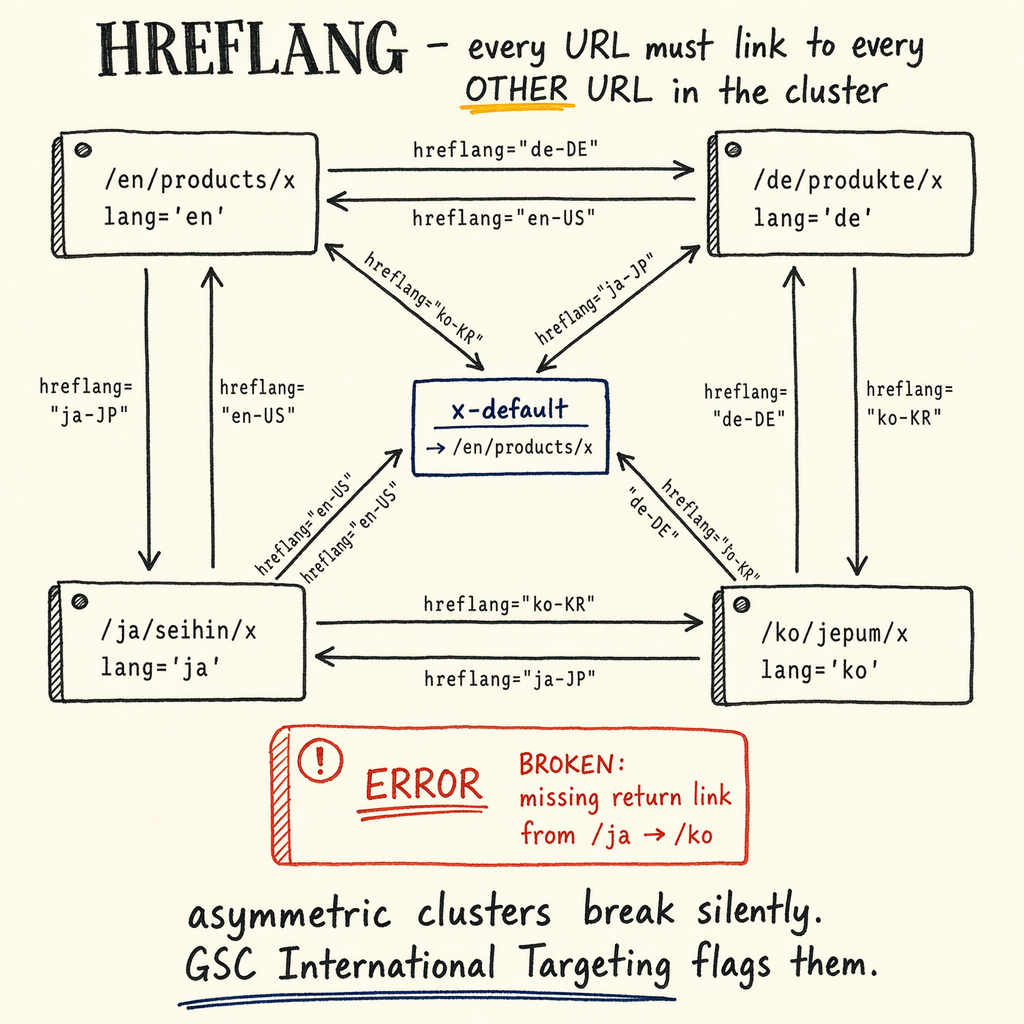
At 7,950 organic clicks/mo in May 2026, enzymes.bio was already getting meaningful demand. But with 1.4% sitewide CTR, avg position 12.4, and 35 languages via TranslatePress, the real risk was not traffic volume. It was search engines sending the wrong language page to the wrong market.
That matters because international SEO is not a translation checkbox. If Google sees /en-gb/ without a matching return tag from /en-us/, or if your canonical points somewhere else, the cluster starts to fragment. The result is usually the same: impressions stay high, clicks stay flat, and you get keyword cannibalization across language variants.
For multi-language sites, hreflang implementation is the control layer. It tells Google which URLs are equivalents, which one should serve by locale, and when x-default should catch unmatched traffic. If you want the framework behind this page, pair it with multi-language SEO and canonical tags.
Choose the right format
HTML links
Best when the page template is stable and each localized URL can output a full reciprocal set. Most CMS themes can handle this cleanly, but only if every locale renders the same cluster.
XML hreflang sitemap
Best for large sets, headless builds, or pages where the <head> is hard to control. This is often the safer route for sites with thousands of localized URLs and strict template variation.
HTTP header
Best for non-HTML assets like PDFs. It is also useful when HTML is not the delivery layer. Keep the return tags symmetrical, or Google will ignore the signal.
x-default fallback
Use this when you need a neutral entry point for unmatched users. It should not replace a real locale. It is the escape hatch, not the primary country page.
Build symmetric clusters
- 01
Map every equivalent URL
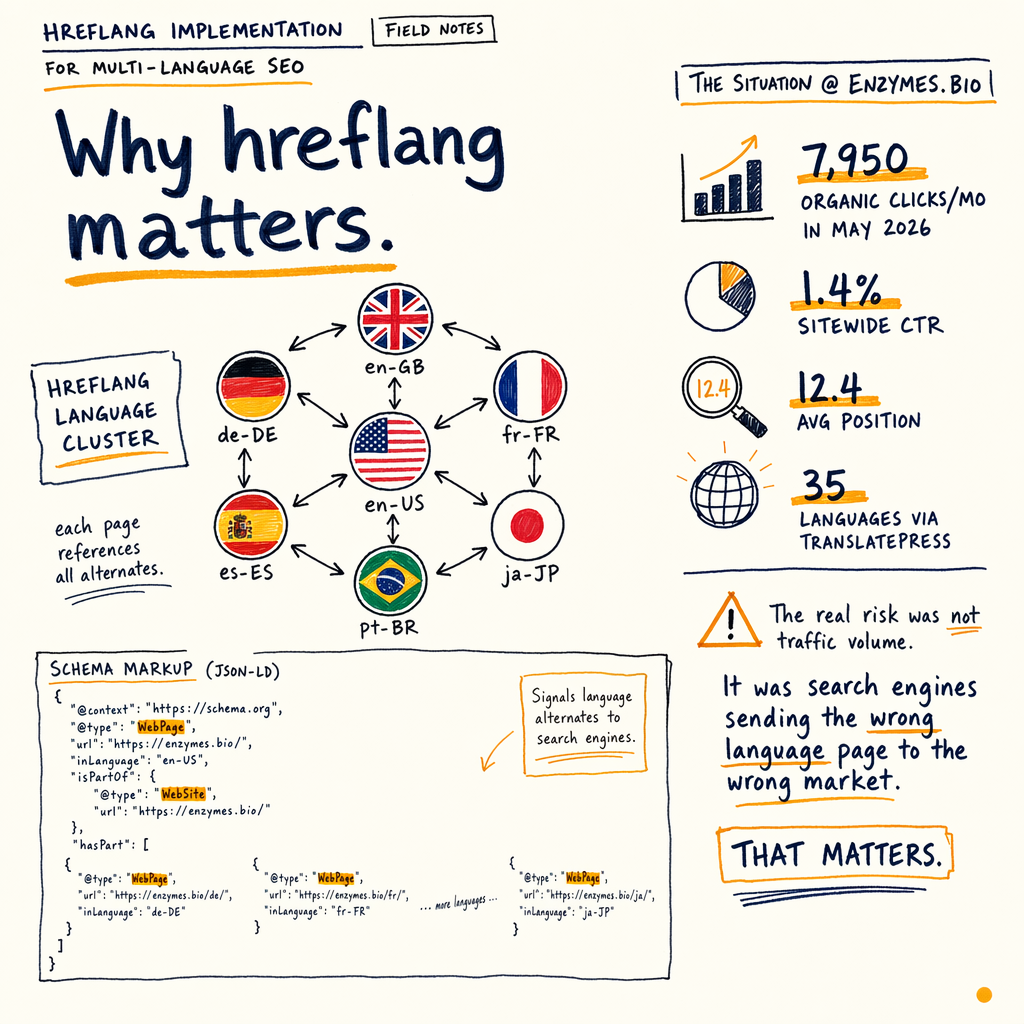
Start with a spreadsheet of equivalent pages across languages and regions. Each row should include the canonical URL, every alternate URL, the language-region code, and the fallback URL if one exists.
- 02
Make every tag reciprocal
If
/en-us/pagepoints to/en-gb/page, then/en-gb/pagemust point back to/en-us/page. This is the return-tag rule. One-way links do not form a valid cluster. - 03
Keep canonicals self-referential
The canonical for each localized page should usually point to itself, not to the global version. If the canonical points elsewhere, Google may ignore hreflang and consolidate signals to the wrong URL.
- 04
Use the same language set everywhere
Every page in the cluster should list the same alternate set, including
x-defaultwhen used. Missing a single locale from one page can break symmetry for the whole cluster.
Pick the right code pairings
| Field | Preferred | Avoid |
|---|---|---|
Language only |
| Using |
Language-region |
| Mixing region codes without a clear localization reason |
Fallback |
| Using a country page as a fake fallback |
Canonical | Self-referential canonical on each locale URL | Canonicalizing all locales to the root language page |
Delivery | One method per URL set, consistently applied | Combining partial HTML tags with incomplete sitemap entries |
Example HTML implementation
<link rel="alternate" hreflang="en-us" href="https://example.com/en-us/product/" />
<link rel="alternate" hreflang="en-gb" href="https://example.com/en-gb/product/" />
<link rel="alternate" hreflang="de-de" href="https://example.com/de-de/produkt/" />
<link rel="alternate" hreflang="x-default" href="https://example.com/product/" />

<link rel="canonical" href="https://example.com/en-us/product/" />
Use x-default correctly
x-default is for the page that should catch users when no locale match is appropriate. It is common on language selectors, global landing pages, or routing pages. It is not a substitute for a missing local page.
If you already have a strong global page, keep x-default pointing there. If you do not, create a neutral selector that helps Google and users land on the right locale. A bad x-default often becomes a soft error: the cluster technically exists, but the fallback does not help search intent.
A practical rule: if a visitor from Canada lands on your English content, should they see en-CA, en-US, or x-default? If the answer depends on price, shipping, or legal terms, the page should be region-specific. If it does not, a language-only page may be enough.
Fix return-tag errors
Return-tag errors are the classic hreflang failure mode. Page A references Page B, but Page B does not reference Page A. That breaks reciprocity and can cause Google to ignore the pair.
The fix is structural, not cosmetic. Check the rendered HTML, the XML sitemap, and any language switcher output. Then confirm that every locale is listed everywhere it should be listed. If you need a troubleshooting checklist, use fix hreflang return-tag errors.
On large sites, these errors often come from one of four places: template exceptions, pagination, partial translation rollouts, or incorrect canonical logic. The most common mistake is assuming the homepage is fine, so the rest of the site must be fine too. It usually is not.
Validate in GSC
- ✓
Open
Performance › Search resultsand compare clicks, impressions, CTR, and average position by query and page for each locale. - ✓
Check
Indexing › Pagesfor spikes inDuplicate, Google chose different canonical than userandCrawled - currently not indexed. - ✓
Review
Indexing › Sitemapsto confirm every locale sitemap is submitted and processed. - ✓
Use
Experience › Core Web Vitalsto confirm that localized templates are not failing on mobile. - ✓
Inspect
Enhancements › Breadcrumbs,Enhancements › Product snippets, andEnhancements › FAQfor locale-specific rich result errors. - ✓
Look at
Settings › Crawl statsfor crawl demand shifts after adding new locales or changing routing. - ✓
If available, review
Settings › International Targetingonly as a legacy reference, not as the source of truth. - ✓
Use
Links › External linksto confirm that the site’s main rate-limiter is not link equity, because enzymes.bio had0 external backlinksand still grew through cleaner indexing.
Audit with curl
curl -I https://example.com/en-gb/product/
curl -s https://example.com/sitemap-hreflang.xml | grep -E 'hreflang|loc'
curl -s https://example.com/en-us/product/ | grep -i 'alternate'
Common implementation patterns
Single-template CMS
Use HTML tags in the <head> and keep the alternate list generated from a shared locale map. This is the simplest path when all locales share the same page type.
Headless or hybrid stack
Prefer XML sitemaps when the front end and content source are separated. It is easier to validate one sitemap feed than several rendering paths.
PDF or non-HTML assets
Use HTTP headers for files that cannot carry HTML tags. Make sure the header returns the same cluster logic as the page versions.
Mixed translation states
If some locales are unfinished, avoid publishing half-clusters. It is better to ship one complete set than five partial sets with broken reciprocity.
JSON-LD for documentation
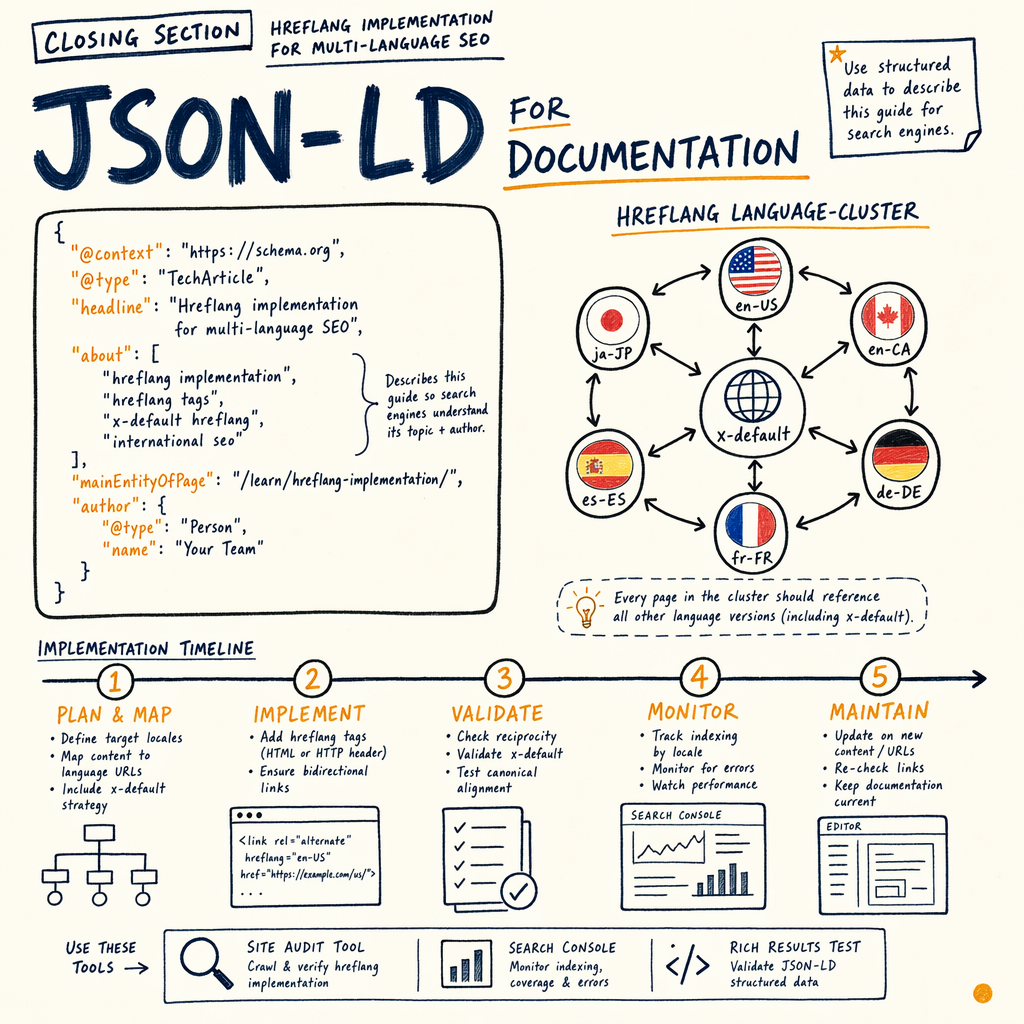
{
  "@context": "https://schema.org",
  "@type": "TechArticle",
  "headline": "Hreflang implementation for multi-language SEO",
  "about": ["hreflang implementation", "hreflang tags", "x-default hreflang", "international seo"],
  "mainEntityOfPage": "/learn/hreflang-implementation/",
  "author": {
    "@type": "Person",
    "name": "Mike"
  }
}
FAQ
Should every localized page have the same hreflang set?
Yes. Symmetry matters. If one page has en-US, en-GB, and x-default, the other pages in that cluster should list the same set, with their own self-references included.
Should canonical and hreflang point to different URLs?
Usually yes. Each locale page should usually canonicalize to itself, while hreflang points to the alternates. If the canonical points to another locale, Google may consolidate the cluster incorrectly.
Is `x-default` required?
No, but it is useful when you need a neutral fallback or selector page. If you do not have a clear fallback URL, do not invent one just to satisfy a checklist.
What is the best format for large sites?
For large or complex sites, XML hreflang sitemaps are often easier to maintain and audit. HTML tags are fine when templates are stable and the locale set is not sprawling.
How do I know hreflang is broken?
Look for indexation drift, wrong-market pages ranking, return-tag errors, or cluster members missing from Performance › Search results. Also check Indexing › Pages for canonical mismatches.
What about legacy International Targeting?
Settings › International Targeting is legacy only. Treat it as historical context, not proof that hreflang is valid or that Google is selecting the right locale.