Technical SEO Audit Service
**7,950 organic clicks/mo can still hide a broken technical setup when 591,000 URLs are not indexed and the site has 0 external backlinks.** This audit finds the crawl, index, render, and reporting issues that cap growth before the content team wastes another sprint.
What the audit fixes
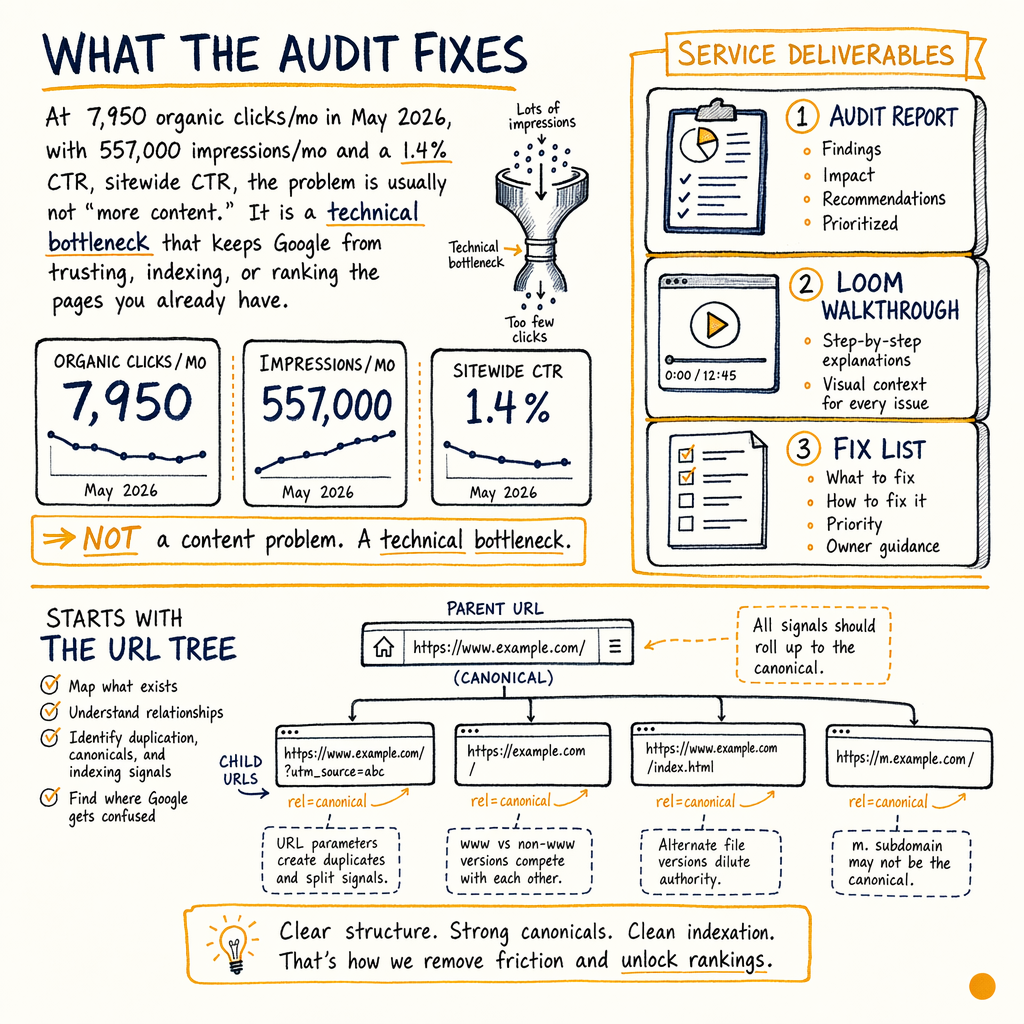
At 7,950 organic clicks/mo in May 2026, with 557,000 impressions/mo and a 1.4% sitewide CTR, the problem is usually not “more content.” It is a technical bottleneck that keeps Google from trusting, indexing, or ranking the pages you already have.
A proper technical SEO audit service starts with the symptom, not a template. If Indexing › Pages shows 16,100 indexed pages and 591,000 not indexed, the audit has a clear target: find what is being crawled, what is being dropped, and which rules are blocking value.
This is the kind of audit you need when traffic is flat, average position sits at 12.4 overall or 11.8 for May 2026, and the site has product, category, or content URLs that should rank but don’t. The fix list should be specific enough to hand to a developer, not a strategist.
You get a GSC-first review, a Notion delivery doc, and a prioritized implementation list. If the issue is deeper than a standard professional seo audit, the scope moves into recovery work instead of generic recommendations.
What Google sees
Indexing patterns
I read Indexing › Pages before anything else. On real audits, the split between indexed and not indexed tells you whether Google is choosing to ignore duplicates, thin variants, parameter URLs, or pages blocked by canonicals, redirects, or noindex.
Sitemap truth
Indexing › Sitemaps should not be a vanity report. It should confirm submitted URLs, discovered URLs, and the gap between what the XML file claims and what Google actually accepts into the index.
Crawl budget signals
Settings › Crawl stats shows whether Googlebot is spending time on low-value URLs, redirect chains, or stale parameter patterns. If crawl demand is wasted, the indexation ceiling stays low.
Rendering and CWV
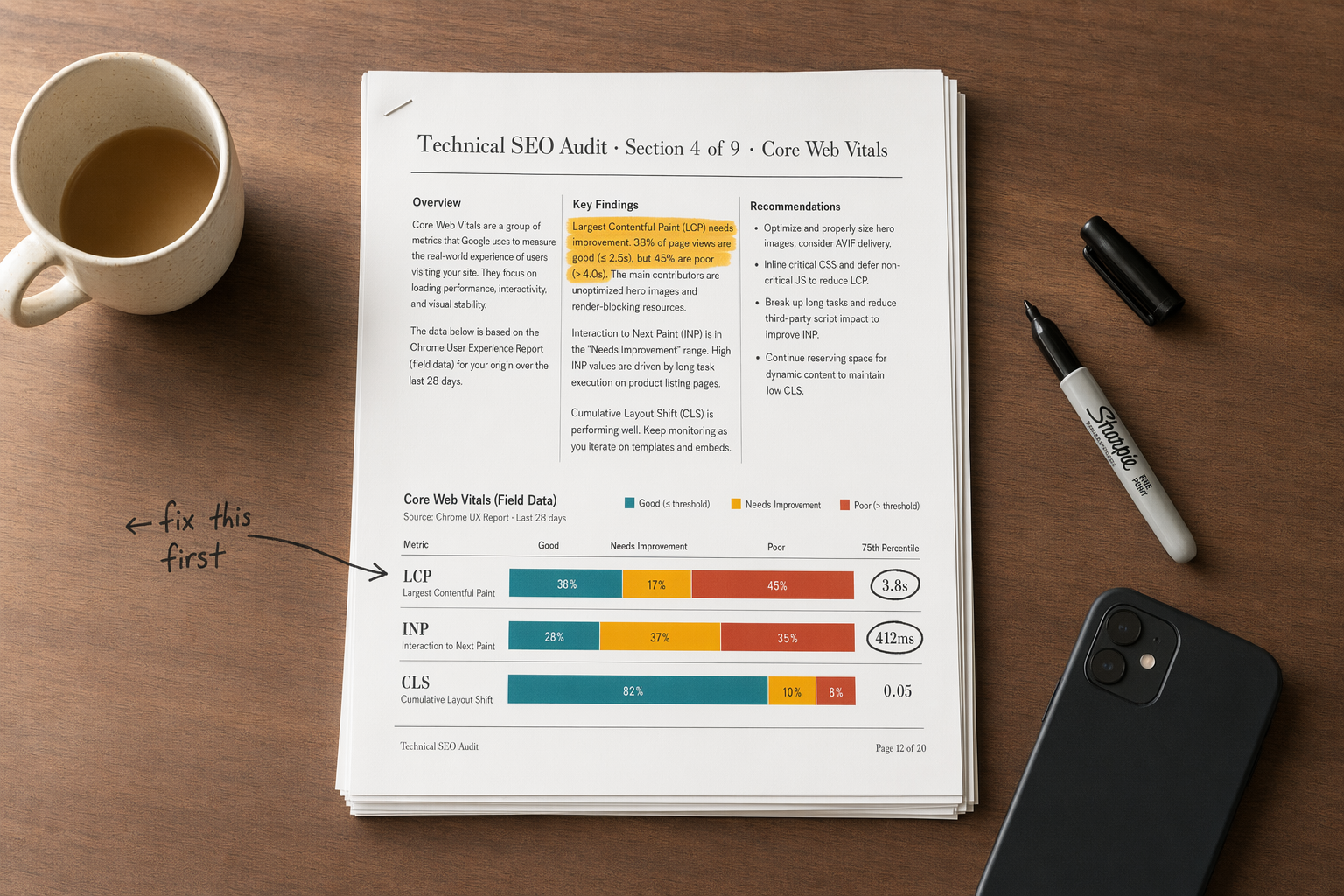
Experience › Core Web Vitals plus render checks in DevTools expose whether layout shifts, lazy-loaded content, blocked JS, or heavy templates are suppressing discovery and usability.
Schema validation
Enhancements › Breadcrumbs, Enhancements › Product snippets, and Enhancements › FAQ tell you whether structured data is valid, eligible, and actually earning enhanced results.
External authority gap
Links › External links matters because the rate-limiter on enzymes.bio was 0 external backlinks. When a site has no external authority, technical cleanup has to be tighter, not looser.
Five-step process
- 01
Baseline in GSC
I start with
Performance › Search results,Indexing › Pages,Indexing › Sitemaps, andSettings › Crawl stats. That gives a clean baseline for clicks, impressions, CTR, average position, crawl demand, and index coverage before any assumptions get made. - 02
Find the bottleneck
Next, I separate crawl, index, render, and authority issues. That means checking canonicals, redirects,
robots.txt, parameter handling, duplicate templates, templating drift, and whether important URLs are simply invisible to Google. - 03
Validate templates
I sample page types, not just URLs. Product pages, collections, blog posts, and translated variants can fail for different reasons. On a multilingual site like enzymes.bio with
35 languagesvia TranslatePress, template-level issues are often the hidden cause of index bloat. - 04
Quantify impact
Every issue gets a severity score tied to search impact. A blocked product template is not the same as a missing breadcrumb schema item. The audit separates revenue blockers from hygiene items so the fix list stays actionable.
- 05
Deliver the fix list
You get a Notion document with issue evidence, screenshots, examples, and implementation notes. For teams that want a second pass, I can extend the engagement into recovery work, usually starting at
$5,000.
What you get
| Field | This audit | Generic site audit |
|---|---|---|
Data source | GSC-first, then crawl and template checks | Mostly crawler output |
Output | Prioritized Notion fix list | Long list of issues |
Scope | Crawl, index, render, schema, CWV, links | Usually only surface checks |
Decision support | Severity, impact, and owner hints | Mixed recommendations |
Delivery | Practical implementation notes | High-level summary |
Best for | Sites with growth blocked by technical debt | Sites needing a quick scan |
Case evidence
The enzymes.bio audit is a useful benchmark because it had real scale and real constraints. The site reached 943 orders to date, 240,809 lifetime revenue, and a 255 AOV, yet still had 0 external backlinks. That combination matters: the site was already converting, but it was missing external authority and had to depend on technical precision to keep scaling.
The measured snapshot also showed 16,100 indexed pages and 591,000 not indexed. That is not a “small cleanup.” It means the audit had to answer basic questions: which URL types deserve indexation, which are wasting crawl, and which template rules are causing the bloat.
If you want the detailed breakdown, see the enzymes.bio case study. For setup guidance, the Google Search Console guide explains the exact reports used in a GSC-first workflow.
The practical lesson: a comprehensive seo audit should not stop at warnings. It should tell you which problems are suppressing clicks, why they are happening, and what to fix first when developer time is limited.
Example audit evidence
{
  "gsc_reports": [
    "Performance › Search results",
    "Indexing › Pages",
    "Indexing › Sitemaps",
    "Experience › Core Web Vitals",
    "Enhancements › Breadcrumbs",
    "Enhancements › Product snippets",
    "Enhancements › FAQ",
    "Links › External links",
    "Settings › Crawl stats"
  ],
  "site_metrics": {
    "organic_clicks_per_month": 7950,
    "impressions_per_month": 557000,
    "ctr": "1.4%",
    "avg_position": 11.8,
    "indexed_pages": 16100,
    "not_indexed_pages": 591000,
    "external_backlinks": 0,
    "orders_to_date": 943,
    "lifetime_revenue": 240809,
    "aov": 255,
    "languages": 35
  },
  "deliverable": "Notion audit doc with prioritized fixes, screenshots, and implementation notes"
}
Audit deliverables
Issue inventory
A structured list of indexation, crawl, render, schema, and internal linking issues, grouped by page type and severity.
Prioritized fixes
Each finding gets a practical priority, not a generic red/yellow/green label. The goal is to show what moves the metric, not what looks tidy.
Evidence screenshots
I include GSC screenshots, page source notes, and DevTools references where the issue is visible. That reduces back-and-forth with dev teams.
Template notes
If the issue repeats across product, category, or article templates, the audit calls it out once and maps the affected URL patterns.
Implementation guidance
You get plain-language instructions for headers, canonicals, schema, pagination, internal links, sitemaps, and crawling rules.
Optional recovery plan
If the site needs deeper fixes after the audit, recovery engagements start at $5,000 and cover execution support, validation, and follow-up checks.
How pricing works
- 01
Audit scope from $1,500
A focused audit starts at
$1,500. That is for a defined set of templates, a clear GSC baseline, and a prioritized list of fixes. - 02
Recovery from $5,000
If the site has entrenched indexation debt, international complexity, or template-level defects across many URLs, recovery work starts at
$5,000. - 03
Scope by risk
Higher page counts, 35-language setups, ecommerce faceted navigation, and weak link profiles all increase audit depth. The price follows the work, not a generic package.
- 04
No bloated retainers
You do not need a months-long retainer to get a serious diagnosis. The audit is designed to answer the core questions fast, then hand off implementation.
- 05
CTA
If you need a technical SEO audit service that is scoped to the actual bottleneck, use Request an audit or See all services.
What the report includes
The final report is built for execution. It is not a slide deck full of vague advice, and it is not a crawler export with no context.
You get:
- a concise summary of the top blockers,
- evidence from GSC and page-level checks,
- template-level patterns across the site,
- a fix list ordered by search impact,
- and notes a developer can use without translation.
For structured sites, I also check whether breadcrumbs, product snippets, FAQ, and related enhancement reports are aligned with the visible markup. If GSC says an enhancement is invalid, the audit identifies why before the issue spreads across templates.
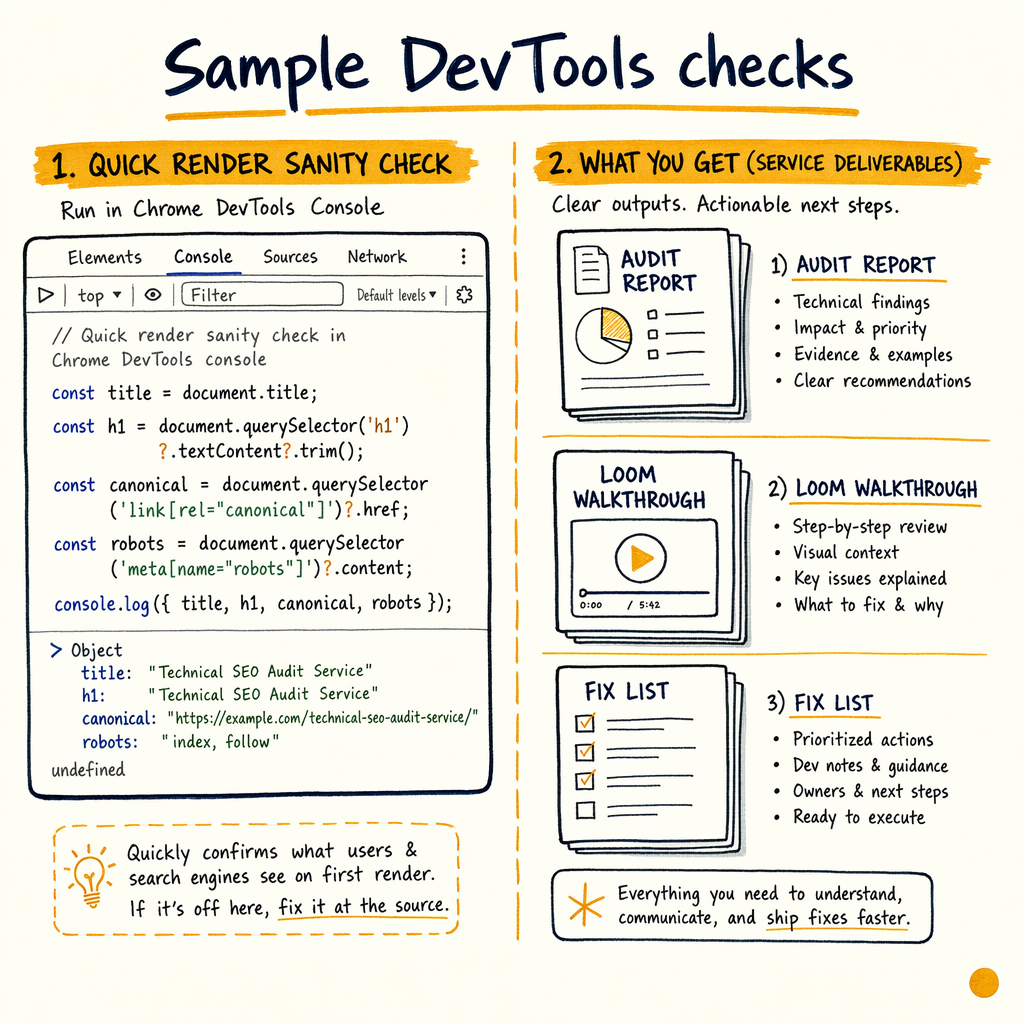
Sample DevTools checks
// Quick render sanity check in Chrome DevTools console
const title = document.title;
const h1 = document.querySelector('h1')?.textContent?.trim();
const canonical = document.querySelector('link[rel="canonical"]')?.href;
const robots = document.querySelector('meta[name="robots"]')?.content;

console.log({ title, h1, canonical, robots });

// If key content only appears after JS hydration, compare:
performance.getEntriesByType('navigation')[0]?.domContentLoadedEventEnd;
performance.getEntriesByType('navigation')[0]?.loadEventEnd;
FAQ
What does a technical seo audit service cover?
It covers crawlability, indexation, rendering, Core Web Vitals, schema, internal links, sitemaps, and the GSC reports that prove where Google is stuck. The audit is built to explain why the site is underperforming, not just to list errors.
How much does a professional seo audit cost?
A focused audit starts at $1,500. Recovery work starts at $5,000 when the site has broader indexation debt, international complexity, or template issues across many URLs.
How long does the audit take?
Most audits move quickly once GSC access and a clear URL scope are available. The timeline depends on page count, template complexity, and whether the site needs deeper log or render analysis.
Do you need crawl data from another tool?
No. The workflow is GSC-first. Crawl data is useful, but it should confirm the problem, not define it on its own.
Can this help with a sitewide indexing problem?
Yes. If Indexing › Pages shows a large gap between indexed and not indexed URLs, the audit will map the cause to template rules, crawl waste, duplication, or rendering issues.
Do you work with ecommerce and multilingual sites?
Yes. Ecommerce, faceted navigation, and multilingual setups are common reasons to need a site audit service. A 35-language site needs template discipline, sitemap hygiene, and careful index controls.