Schema Markup Implementation Service for Rich Results
**If Google can’t parse the page cleanly, the rich result won’t appear.** This schema markup service maps entities to JSON-LD, validates the output, and ships markup that can support CTR gains on eligible pages.

What schema fixes
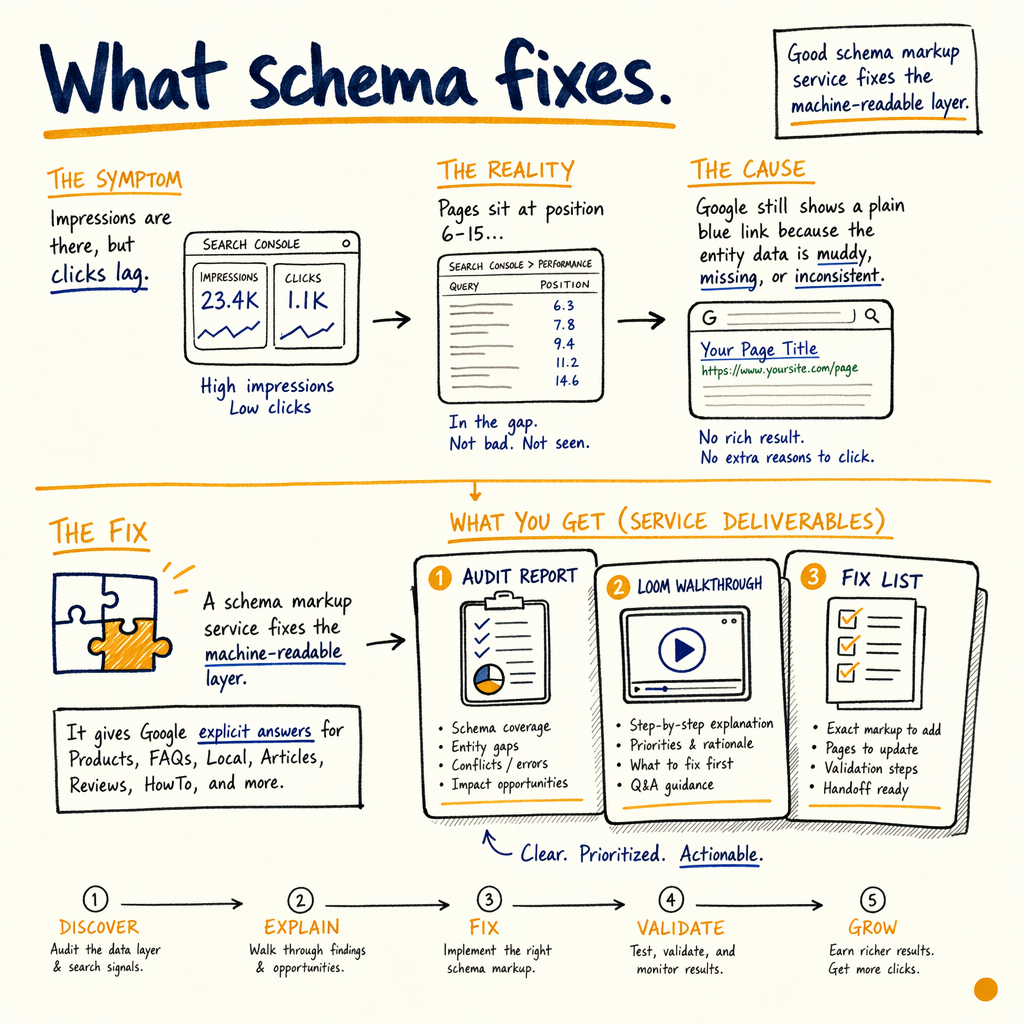
The symptom is usually plain: impressions are there, but clicks lag. Pages sit at position 6-15, yet Google still shows a plain blue link because the entity data is muddy, missing, or inconsistent.
A good schema markup service fixes the machine-readable layer. It gives Google explicit answers for Product, Organization, Breadcrumb, FAQ, HowTo, Article, and related entities, so the page is easier to classify and easier to trust.
This matters most when the page already has demand. On the enzymes.bio audit, the site had 7,950 organic clicks/mo in May 2026, 557,000 impressions/mo, and only 1.4% CTR sitewide. With 16,100 indexed pages and 591,000 not indexed, the problem was not “more content.” It was cleaner indexing, clearer entity signals, and fewer ambiguous pages.
Schema is not magic. It will not fix weak intent match or thin pages. But when the content is already relevant, structured data implementation can be the difference between a regular result and a richer SERP treatment.
What gets implemented
Entity mapping first
The work starts by mapping the business, page type, and target query to the right schema graph. That avoids copy-paste markup that says the wrong thing.
JSON-LD only
Implementation uses application/ld+json because it is easier to maintain, easier to validate, and less likely to break page rendering.
Page-level + sitewide markup
You get a mix of page-specific schemas and global entities, including Organization, WebSite, BreadcrumbList, and relevant content-type markup.
Validation against GSC and Google tests
Markup is checked in Google tooling, then verified against Performance › Search results and Enhancements › Product snippets or similar reports when data starts flowing.
Change-safe delivery
The output is built to fit CMS templates, head injection, or component-level rendering. That keeps the markup from drifting when content updates.
CTR-focused logic
If the page can qualify for richer presentation, the schema is written to support it. The goal is not extra code. The goal is a cleaner result in the SERP.
How the process works
This is a 5-step process because schema work fails when it gets hand-waved. The page type, template constraints, and GSC data all need to line up before anything ships.
First, the audit identifies the templates with search demand and click inefficiency. Then the page inventory is grouped by entity type, so a product page does not inherit article markup and a category page does not pretend to be a blog post.
If you need broader SEO triage, this work usually pairs with a technical SEO audit. If you want the full service list first, use services.
The goal is practical: deploy the right schema, validate it, and measure the delta in Performance › Search results after Google recrawls the pages.
How the process works
- 01
Audit the templates
Start with GSC, crawling, and page template review. Find the pages that already get impressions, especially those with position 4-20 and low CTR. Those are the best candidates for rich-result work.
- 02
Map the entities
Define the business entity, page entity, and relationship graph. For example:
Organizationowns the brand,BreadcrumbListdefines hierarchy, andProductorFAQPagedescribes the content on the page. - 03
Write the JSON-LD
Build clean JSON-LD with stable IDs, canonical URLs, and only the properties that match the visible page content. No stuffing. No fake reviews. No invented FAQ answers.
- 04
Validate and test
Run the markup through a schema validator and browser checks. Confirm that it parses cleanly, survives template rendering, and does not collide with duplicate scripts or conflicting plugins.
- 05
Monitor in GSC
Watch
Enhancements › Product snippets,Enhancements › FAQ,Enhancements › Breadcrumbs, andPerformance › Search resultsfor impressions, clicks, and CTR changes after recrawl.
What good markup looks like
| Field | Low-quality implementation | Technical SEO implementation |
|---|---|---|
Entity mapping | Generic template markup copied sitewide | Page-type-specific entities mapped to visible content |
Format | Microdata scattered through HTML | Clean JSON-LD in a single block or stable component |
Validation | No testing after deployment | Checked in validator and browser tools before launch |
Search result impact | No measurable change | CTR uplift on eligible pages, often from richer presentation |
Maintenance | Breaks when CMS content changes | Template-safe and monitored in GSC reports |
Risk | Conflicting schema, invalid properties, stale data | Minimal output, accurate properties, no fabricated signals |
Schema types we deploy
The exact package depends on the template and the search intent. A content site usually needs a different graph than an ecommerce catalog, and both differ from a service page.
Typical deployments include Organization, WebSite, BreadcrumbList, Article, FAQPage, HowTo, Product, Offer, Review, AggregateRating, LocalBusiness, and Service. For reference and implementation notes, see schema markup types.
On ecommerce pages, Product plus Offer is usually the core. On service pages, the biggest wins often come from Organization, WebPage, BreadcrumbList, and tightly written FAQPage content that actually matches the visible copy.
If the page has a knowledge-rich structure, ImageObject, VideoObject, or HowToStep can help too. The rule is simple: if it is not on the page, it does not go in the JSON-LD.
Common implementation packages
New-site schema setup
For launches, the work includes base entities, template logic, and validation before go-live. That usually covers Organization, WebSite, BreadcrumbList, and the primary page types.
Schema recovery engagement
For broken or missing markup, the focus is error removal, property cleanup, and template fixes. Recovery engagements start at $5,000 because they usually involve code, QA, and revalidation.
Audit-only schema review
If you want a scoped review first, audits start at $1,500. You get the entity map, issue list, and implementation notes for your dev team.
Ecommerce rich-results package
Built for Product, Offer, AggregateRating, and breadcrumb coverage. This is the format most likely to affect snippet quality on category and product pages.
Content and FAQ package
Built for editorial, guides, and service pages that can support Article, FAQPage, and BreadcrumbList without padding the markup with nonsense.
Platform migration cleanup
Useful after CMS migrations or theme changes. It removes duplicate schema, restores missing entities, and checks for malformed scripts that block parsing.
Example JSON-LD
{
  "@context": "https://schema.org",
  "@graph": [
    {
      "@type": "Organization",
      "@id": "https://example.com/#organization",
      "name": "Example Brand",
      "url": "https://example.com/"
    },
    {
      "@type": "WebPage",
      "@id": "https://example.com/product/widget/#webpage",
      "url": "https://example.com/product/widget/",
      "name": "Widget",
      "isPartOf": { "@id": "https://example.com/#website" },
      "about": { "@id": "https://example.com/#organization" }
    },
    {
      "@type": "BreadcrumbList",
      "@id": "https://example.com/product/widget/#breadcrumbs",
      "itemListElement": [
        {
          "@type": "ListItem",
          "position": 1,
          "name": "Home",
          "item": "https://example.com/"
        },
        {
          "@type": "ListItem",
          "position": 2,
          "name": "Products",
          "item": "https://example.com/products/"
        },
        {
          "@type": "ListItem",
          "position": 3,
          "name": "Widget",
          "item": "https://example.com/product/widget/"
        }
      ]
    }
  ]
}
Validation snippet
curl -sS "https://validator.example.test/inspect?url=https%3A%2F%2Fexample.com%2Fproduct%2Fwidget%2F" \
  -H "Accept: application/json" \
  | jq '.detectedItems[] | {type: .type, errors: .errors, warnings: .warnings}'
DevTools check
[...document.querySelectorAll('script[type="application/ld+json"]')]
  .map((node) => node.textContent)
  .filter(Boolean)
  .forEach((json) => {
    try {
      const parsed = JSON.parse(json);
      console.log(parsed['@type'] || parsed['@graph']?.map((n) => n['@type']));
    } catch (e) {
      console.error('Invalid JSON-LD', e);
    }
  });
Proof from audits
The best schema wins are visible in GSC, not in feelings. On enzymes.bio, the page set already showed 557,000 impressions/mo, 7,950 organic clicks/mo, and avg position 11.8 in May 2026. That means the content was already getting looked at; the job was to improve how it was understood and presented.
The site also had 35 languages via TranslatePress, 16,100 indexed pages, and 591,000 not indexed. That is a classic technical SEO mix: huge surface area, lots of duplication risk, and a need for tighter canonical and entity control.
For that kind of site, schema is not a decorative layer. It is a control layer. It makes page purpose explicit, keeps templates cleaner, and gives Google a better chance to attach the right enhancement to the right URL.
If you want to see the broader audit context, there is a published case study showing how the GSC findings were used to prioritize the work.
When to use this service
- ✓
Your pages earn impressions but CTR is stuck below expected levels.
- ✓
Google shows indexed URLs, but rich-result eligibility is missing or inconsistent.
- ✓
Your CMS has duplicate or conflicting schema from theme and plugin layers.
- ✓
A migration, redesign, or locale rollout changed templates and broke markup.
- ✓
Indexing › Pagesshows large-scale duplication or non-indexed variants. - ✓
Enhancements › Product snippetsorEnhancements › FAQshows errors or no data. - ✓
You need a schema consultant who can write the implementation notes, not just point out the problem.
Pricing and scope
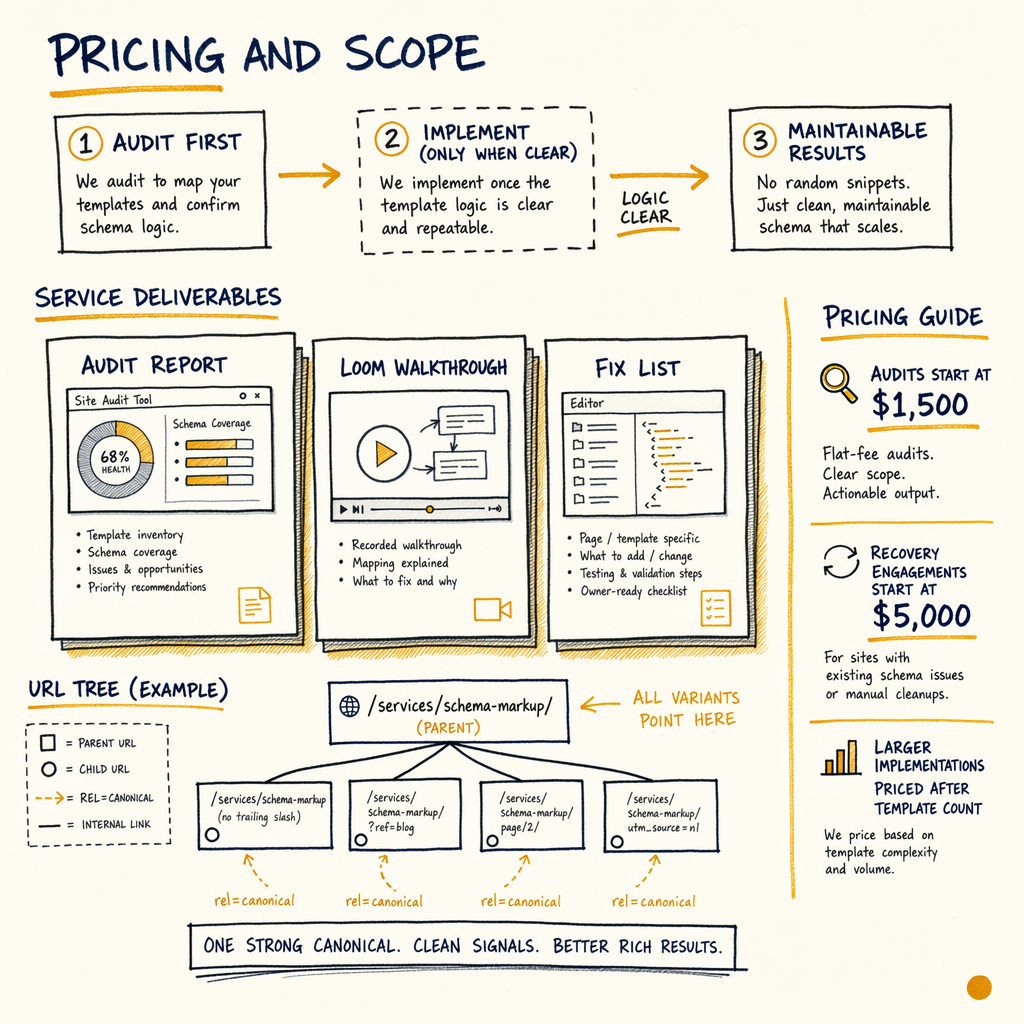
Scope starts with the audit, then moves into implementation only when the template logic is clear. That keeps the work from turning into random schema snippets that no one can maintain.
Audits start at $1,500. Recovery engagements start at $5,000. Larger implementations are priced after template count, page type count, and the amount of code work required.
If you need to compare options, the simplest split is this: audit-first if you need diagnosis and a roadmap; implementation if you already know the pages, templates, and schema types; recovery if markup is broken across a site or CMS migration.
Before launch, the deliverable is usually a Notion doc with the entity map, implementation notes, validation screenshots, and exact URLs to test in Google tools. That keeps dev handoff tight and reduces back-and-forth.
FAQ
What does a schema markup service actually deliver?
You get entity mapping, JSON-LD implementation notes, validation checks, and a rollout plan for the pages most likely to qualify for rich results. On some projects, that also includes code-ready snippets for dev handoff.
Can schema markup improve CTR?
Yes, but only on pages where Google can use the data and the snippet treatment changes. In audit work, the useful benchmark is the page set that already has impressions and sits around positions 4-20. On enzymes.bio, the sitewide baseline was 1.4% CTR with 557,000 impressions/mo, so even small improvements mattered.
Do you work with ecommerce and content sites?
Yes. Ecommerce usually needs Product, Offer, BreadcrumbList, and sometimes AggregateRating. Content and service sites often need Article, FAQPage, Service, and Organization.
Do you fix broken schema after a migration?
Yes. That is one of the most common reasons people hire a schema consultant. Migrations often create duplicate scripts, missing IDs, or template output that no longer matches the page.
How do you validate the markup?
The implementation is checked in a schema validator, then verified in browser DevTools and tracked in GSC reports like Enhancements › Breadcrumbs, Enhancements › Product snippets, and Performance › Search results.
Do I need schema on every page?
No. The goal is coverage where it matters, not markup everywhere. Pages with demand, clear entity relationships, and a realistic chance of rich-result eligibility should come first.