SEO ranking recovery for traffic drops
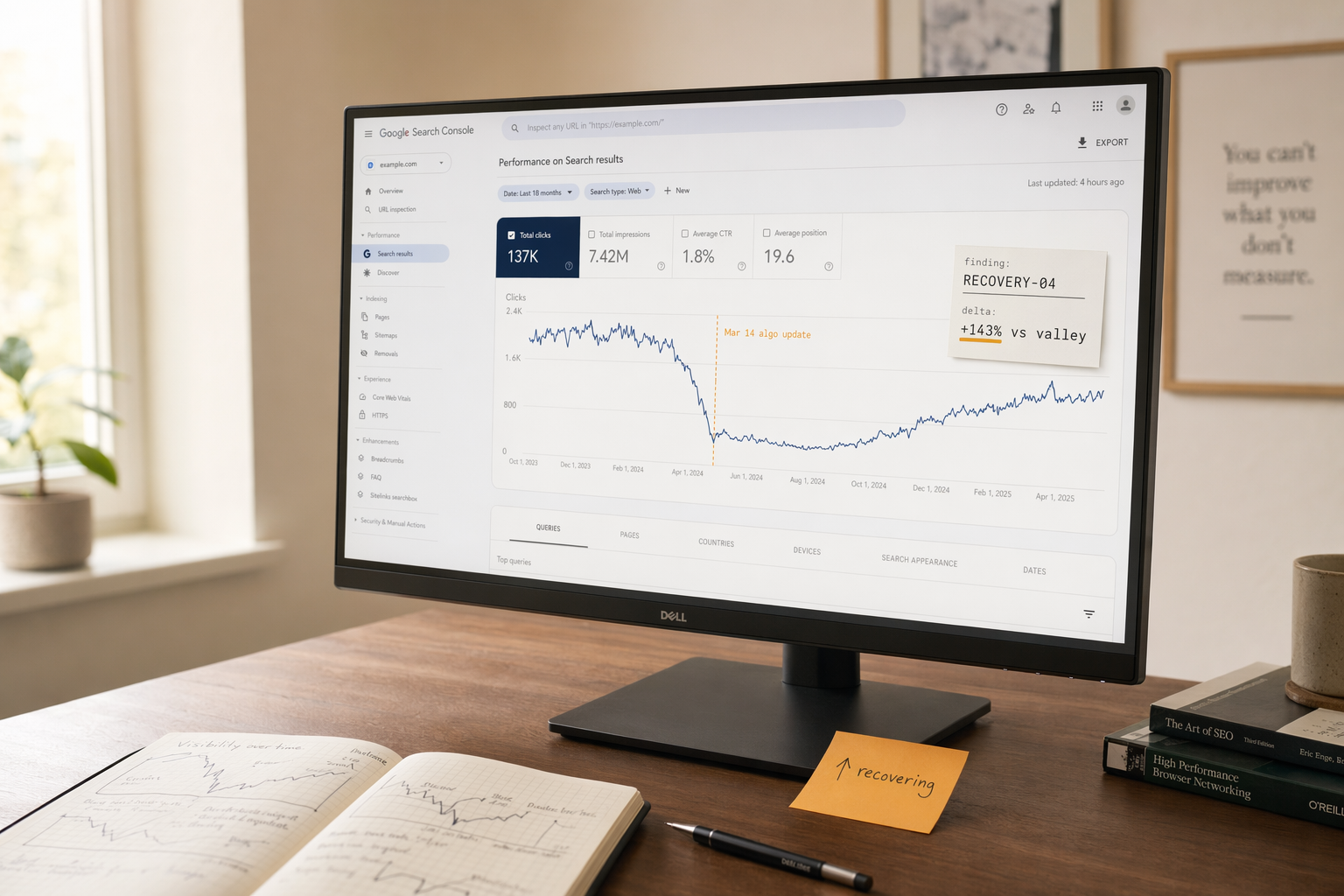
**7,950 organic clicks/mo is not the problem; the drop is.** When rankings fall after a migration, update, or template change, the fix starts with GSC, not guesses.
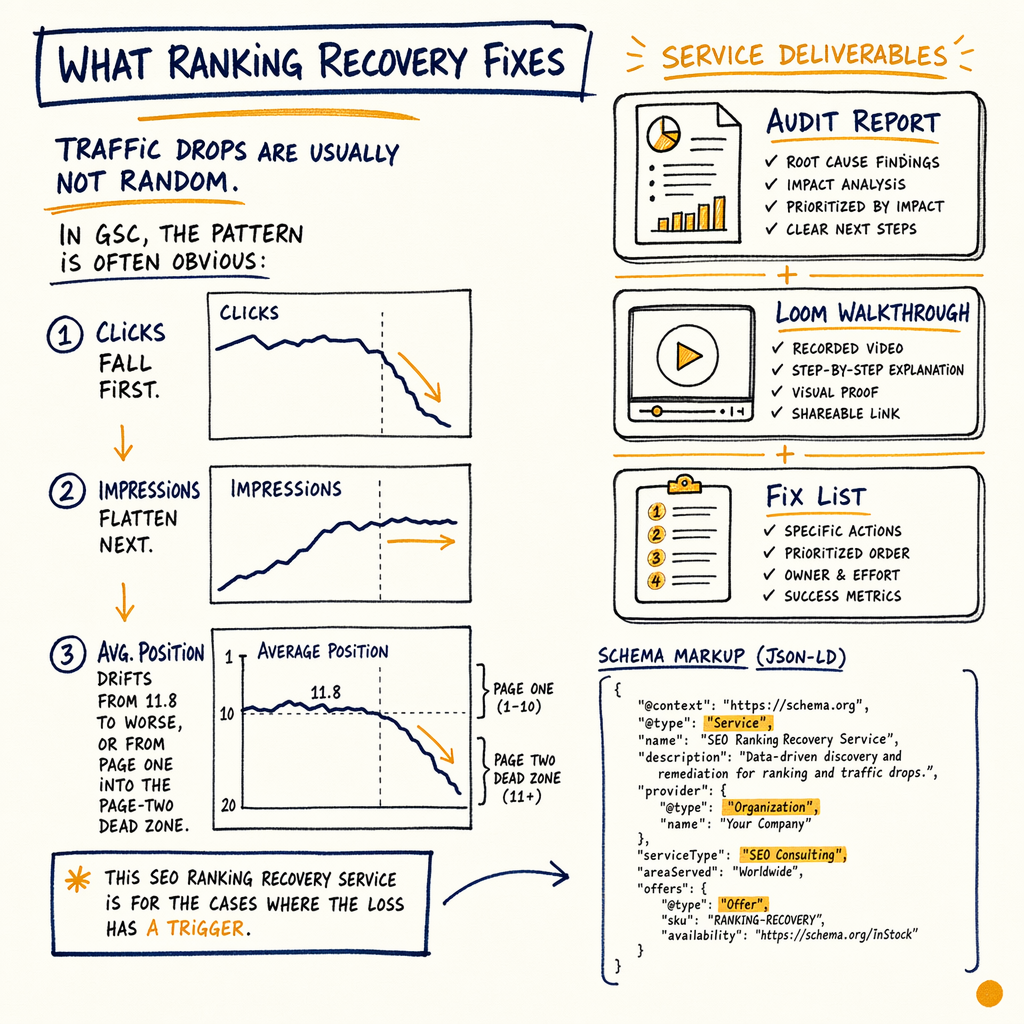
What ranking recovery fixes
Traffic drops are usually not random. In GSC, the pattern is often obvious: clicks fall first, then impressions flatten, then average position drifts from 11.8 to worse, or from page one into the page-two dead zone.
This seo ranking recovery service is for the cases where the loss has a trigger. Common triggers are migrations, URL changes, template releases, internal linking changes, robots.txt mistakes, canonical shifts, and Google updates that expose thin or duplicated sections.
The goal is not a generic audit. The goal is to diagnose traffic loss, isolate the rate-limiter, and produce a fix list that maps to measurable recovery in Performance › Search results and Indexing › Pages.
Why rankings drop
Migration damage
A site can lose rankings after a platform move even when the content “looks the same.” URL swaps, redirect chains, canonical mistakes, and sitemap drift can create a gap between the old URLs Google trusts and the new URLs it can index.
Indexing waste
At enzymes.bio, GSC showed 16,100 indexed pages and 591,000 NOT indexed. That gap is a clue, not a vanity stat. It says Google is spending crawl and indexing effort on URLs that are not pulling weight.
Authority bottlenecks
The site had 0 external backlinks. That is the hard limiter. If rankings are weak, internal architecture and page quality matter more because there is no offsite authority to cushion technical mistakes.
Search intent drift
Sometimes the page is still indexable, but it no longer matches query intent. Titles, headings, schema, or content depth can fall behind the SERP, and rankings slide without an obvious technical error.
Update exposure
Google update recovery usually means the site had latent issues. The update did not “penalize” the site; it surfaced weak differentiation, duplicate templates, or poor content-to-query alignment.
How diagnosis works
The first sprint starts in Performance › Search results, then moves into Indexing › Pages, Indexing › Sitemaps, and Settings › Crawl stats. That sequence matters because ranking drops usually show up in search data before they show up in logs or crawl reports.
For a real recovery engagement, I compare the losing date range against the prior stable period. If clicks dropped from 7,950 organic clicks/mo in May 2026 from 2,770 in May 2025, the question is not “what happened to SEO?” It is: which query groups, templates, and URL sets moved first?
Then I test the suspect layer. If impressions stayed near 557,000/mo while CTR stayed at 1.4%, the page may still be visible but not compelling. If average position sits at 12.4 overall, or 11.8 in May 2026, the issue may be a cluster of pages stuck just below the threshold where clicks compound.
That is how a traffic drop recovery project avoids noisy fixes. Every recommendation has to be tied to a visible delta in GSC.
Five-step recovery process
- 01
Measure the drop
Pull the exact window from
Performance › Search results. I segment by page, query, country, device, and search appearance so the loss is not averaged away. The output is a clear baseline: what fell, when it fell, and how far. - 02
Find the trigger
I check release notes, redirect maps, sitemap changes, canonical tags, internal links, and crawl stats. If the drop lines up with a deployment, that deployment becomes the primary suspect until proven otherwise.
- 03
Test the index layer
I review
Indexing › Pages,Indexing › Sitemaps,Enhancements › Breadcrumbs,Enhancements › Product snippets,Enhancements › FAQ, and any template-level schema issues. This catches orphaning, duplicate grouping, and bad URL discovery. - 04
Rank the fixes
Not every issue is equal. A broken canonical on a money page outranks a missed alt attribute on a blog post. The fix list gets sorted by likely recovery impact, implementation cost, and risk of regression.
- 05
Track recovery
You get weekly progress reporting with before/after GSC snapshots. Recovery is measured in clicks, impressions, position, and index coverage, not in vague “SEO improvements.”
Fix path versus guesswork
| Field | Recovery audit | Generic guesswork |
|---|---|---|
Data source | GSC first: | Mostly screenshots, opinion, and tool alerts |
Root cause | Mapped to URLs, query groups, and release dates | Usually “content needs work” |
Outcome | Fix list with priority, owner, and measurement plan | A long list with no ranking order |
Reporting | Weekly deltas and recovery checkpoints | One-off audit PDF |
Goal | Reverse the traffic loss and stabilize indexing | Feel informed |
What you get
A recovery engagement is built around a Notion doc, not a slide deck. The output is structured so your dev, content, and product teams can act on it without translating SEO jargon.
Typical deliverables include:
- root-cause summary with the most likely failure point
- URL-level impact list
- template-level issue map
- redirect, canonical, and sitemap checks
- internal linking and orphan-page review
- recovery roadmap with priorities
- weekly progress notes during implementation
/services/technical-seo-audit/. If the issue is already clear, the recovery plan can begin immediately.GSC checks I run
{
  "reports": [
    "Performance › Search results",
    "Indexing › Pages",
    "Indexing › Sitemaps",
    "Experience › Core Web Vitals",
    "Enhancements › Breadcrumbs",
    "Enhancements › Product snippets",
    "Enhancements › FAQ",
    "Links › External links",
    "Settings › Crawl stats"
  ],
  "compare": {
    "current_range": "last_28_days",
    "previous_range": "previous_28_days",
    "segment": ["query", "page", "country", "device"]
  },
  "alerts": [
    "clicks_down",
    "impressions_flat_with_ctr_drop",
    "pages_discovered_not_indexed",
    "sitemap_url_count_mismatch",
    "crawl_spikes_without_index_gain"
  ]
}
Proof from audits
Clicks recovered from a low base
Enzymes.bio reached 7,950 organic clicks/mo in May 2026, up from 2,770 in May 2025, a +187% change. That kind of movement usually comes from removing blockers, not from chasing keywords blindly.
Visibility was already there
With 557,000 impressions/mo and only 1.4% CTR, the site was visible enough to collect data. The job was to improve ranking quality and search result attractiveness, not to manufacture demand.
Position was close, not hopeless
An average position of 12.4 sitewide, or 11.8 in May 2026, tells you the site was often near page one. That is the zone where small technical fixes can produce large click gains.
Indexing was the bottleneck
16,100 indexed pages against 591,000 NOT indexed is a signal. It means Google found a massive amount of URL noise, so index hygiene had to be part of the recovery plan.
Revenue proves the page set matters
The site had 943 orders to date, $240,809 lifetime revenue, and a $255 AOV. When money pages slip, the business impact is immediate, which is why recovery work focuses on commercial templates first.
When this service fits
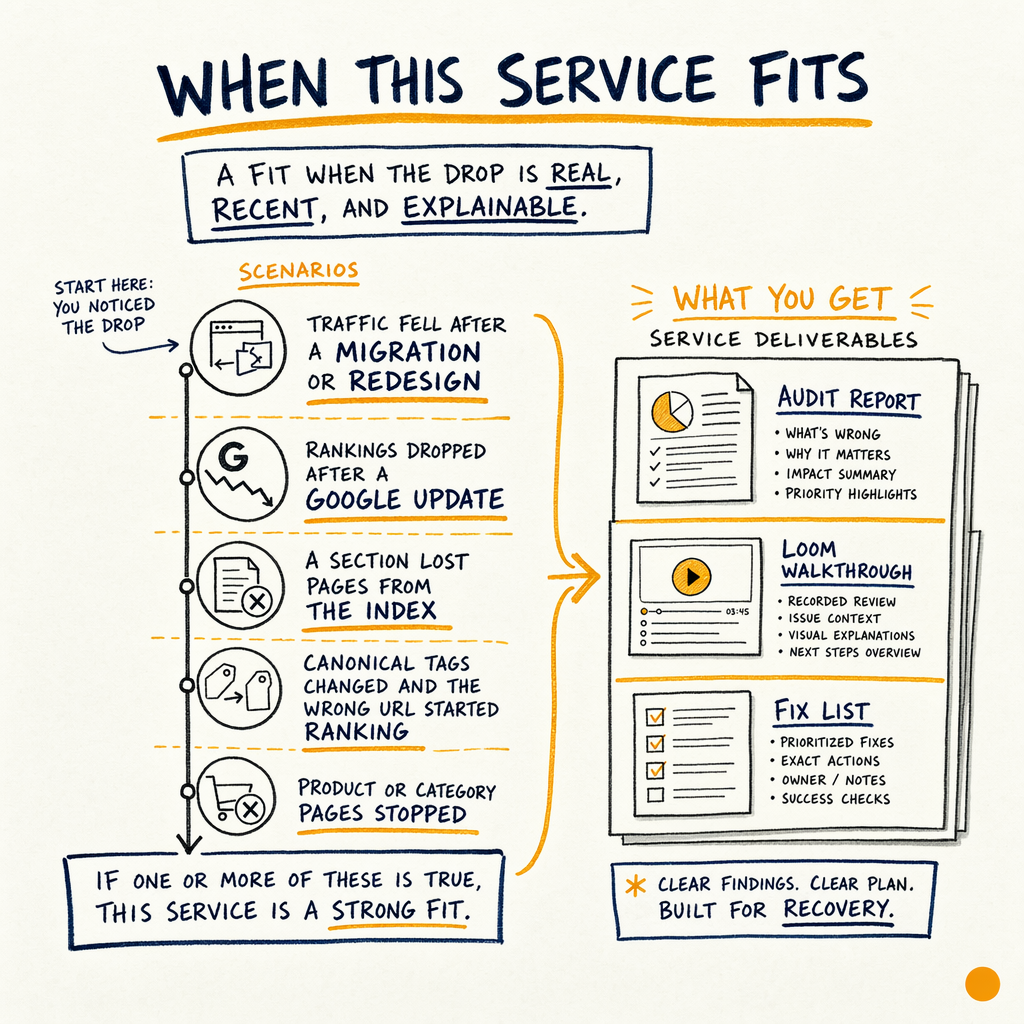
This is a fit when the drop is real, recent, and explainable. Typical scenarios:
- traffic fell after a migration or redesign
- rankings dropped after a Google update
- a section lost pages from the index
- canonical tags changed and the wrong URL started ranking
- product or category pages stopped receiving impressions
- crawl stats rose but indexed pages did not
If you want a concrete example, see the client SaaS migration case study.
FAQ
How is seo ranking recovery different from a technical audit?
A technical audit maps problems. A recovery engagement maps problems, ranks them by likely impact, and stays with the site through implementation and re-measurement.
Can you diagnose a traffic drop without a redesign history?
Yes. GSC often shows the pattern even when release notes are missing. I look for query-level loss, URL clustering, and index coverage shifts first.
What if the site has no backlinks?
That makes technical issues matter more, not less. With 0 external backlinks, the site has less authority buffer, so indexing and architecture need to be tighter.
Do you work before launch?
Yes. Before launch is the cheapest time to catch canonical errors, redirect gaps, sitemap problems, and template issues that would otherwise become a recovery job later.
How fast do you usually find the cause?
Simple cases can be narrowed in the first sprint. Messier cases need a full comparison of GSC, crawl stats, release history, and affected URL sets before the cause is confident.
What happens after the fix list is delivered?
You get implementation priorities and weekly progress checkpoints. Recovery is judged by clicks, impressions, position, and index coverage moving in the right direction.