FAQ Schema Implementation: What Still Works in 2026
**557,000 impressions/month and a 1.4% sitewide CTR means the page is already being seen; the problem is whether FAQ schema still changes the result.** For most sites, FAQ rich results are gone. For a few, JSON-LD still helps Google understand page intent and supports cleaner SERP testing.
What changed in 2026
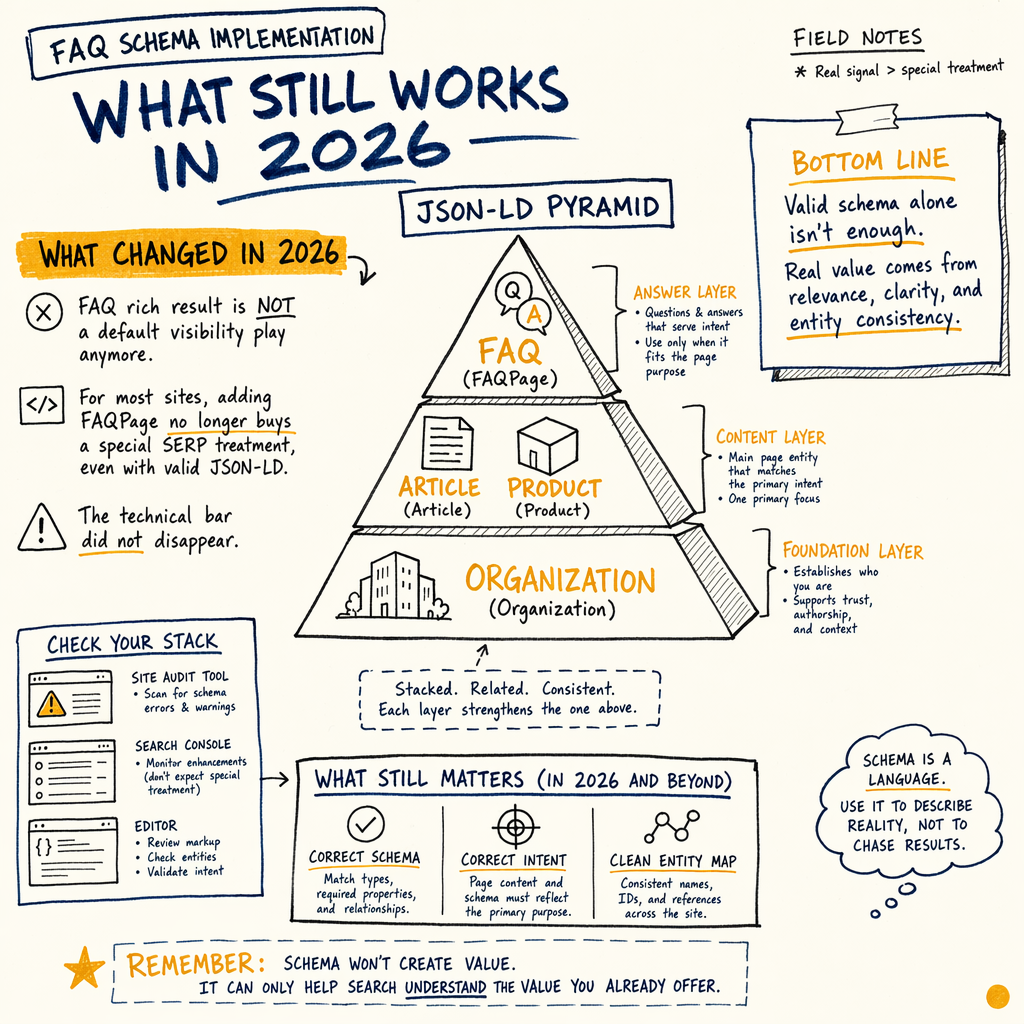
Google’s FAQ rich result is not a default visibility play anymore. For most sites, adding FAQPage no longer buys a special SERP treatment, even when the JSON-LD is valid.
That matters because the technical bar did not disappear. You still need correct schema, correct page intent, and clean entity mapping. On a real audit, Performance › Search results showed 7,950 organic clicks/mo in May 2026, up from 2,770 in May 2025, but CTR was still only 1.4% with average position 12.4. That is the kind of gap schema work can sometimes help diagnose, not magically fix.
If you are deciding whether to implement FAQ schema, use GSC first. Check Indexing › Pages for crawl/index noise, Performance › Search results for query intent, and Enhancements › FAQ only if Google still surfaces the report for your properties. Then validate the JSON-LD with the Schema.org validator and the Rich Results Test.
When FAQ schema still helps
Supports page intent
A well-formed FAQPage can help Google parse question-and-answer sections on support pages, product pages, and policy pages. It is still useful as structured data even when there is no visible FAQ enhancement.
Improves template consistency
If you run hundreds of pages, JSON-LD gives you a repeatable pattern. That matters more than individual rich result wins because broken templates create scale problems fast.
Pairs with other types
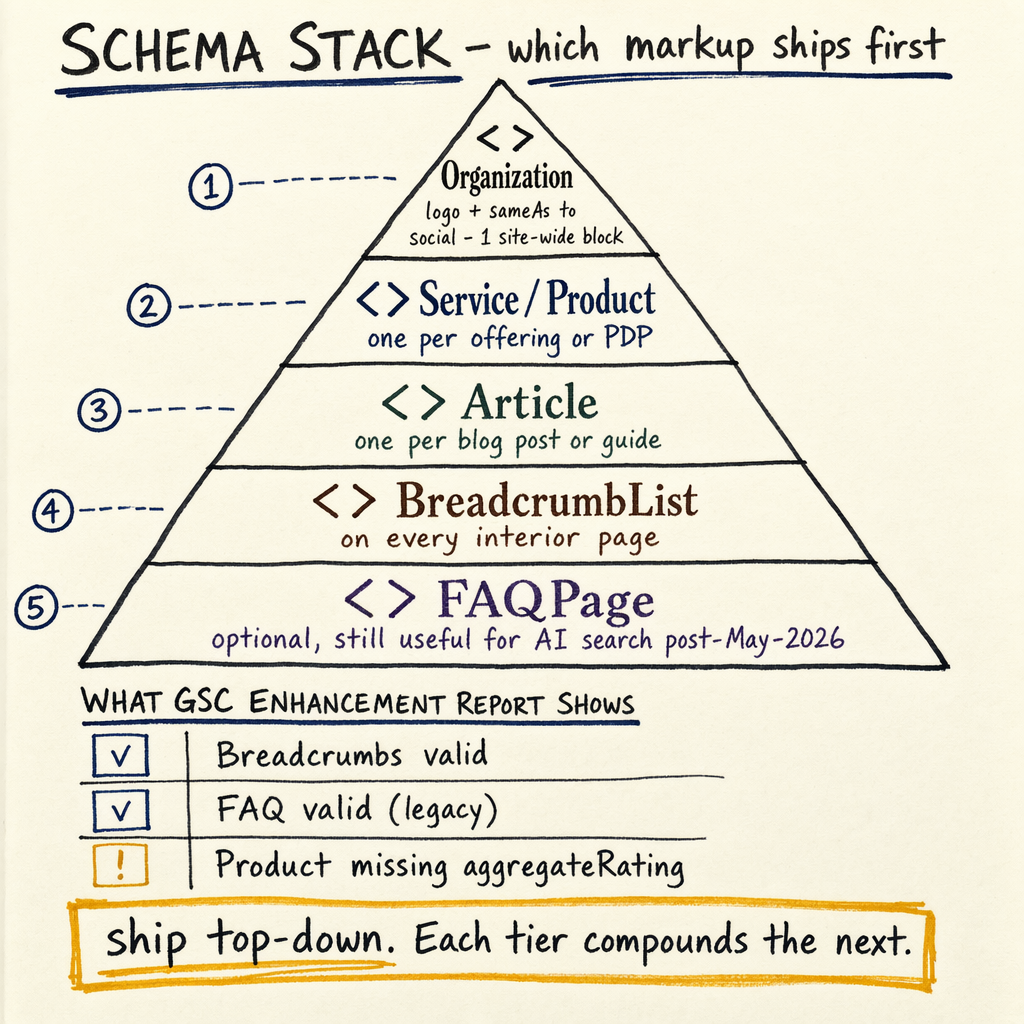
FAQ markup can sit alongside BreadcrumbList, Product, Article, Organization, or Service when the page genuinely supports those entities. The key is matching the schema to the page content, not padding the graph.
Useful in testing
When pages already rank on page 1 or page 2, FAQ schema can be part of a controlled change set. If CTR moves after deployment, you can compare query groups in Performance › Search results instead of guessing.
When not to deploy it
Do not add FAQ schema because the CMS has a box for it. If the page is a thin landing page, a category page with no real Q&A, or a copied support answer, the markup becomes decoration.
That is especially true on sites with structural problems. Enzymes.bio had 16,100 indexed pages and 591,000 not indexed pages, plus 0 external backlinks. In that situation, schema is not the rate-limiter; crawl demand, internal architecture, and authority are.
If you need a decision rule: only implement FAQ schema when the page has unique questions, visible answers, and a clear purpose. Otherwise, spend the time on schema type selection or on the actual implementation service at [/services/schema-markup-implementation/].
Implement JSON-LD safely
- 01
Map the page type first
Decide whether the URL is really a
FAQPage,Product,Article, orService. If it is a product page with an FAQ block, the primary entity is still usuallyProduct, notFAQPage. - 02
Write visible Q&A
Put the questions and answers in the HTML first. JSON-LD should describe what the visitor can already see, not invent extra content.
- 03
Add JSON-LD only
Use script-based JSON-LD in the page head or near the footer. Skip Microdata and RDFa. Keep one canonical
@typeper block unless the page truly contains multiple entities. - 04
Validate the output
Run the URL through the Rich Results Test, then check the raw graph in the Schema.org validator. If the page fails either test, fix the HTML first and the schema second.
Example FAQ JSON-LD
{
  "@context": "https://schema.org",
  "@type": "FAQPage",
  "mainEntity": [
    {
      "@type": "Question",
      "name": "What is FAQ schema?",
      "acceptedAnswer": {
        "@type": "Answer",
        "text": "FAQ schema is JSON-LD that describes visible questions and answers on a page."
      }
    },
    {
      "@type": "Question",
      "name": "Should every page use FAQ schema?",
      "acceptedAnswer": {
        "@type": "Answer",
        "text": "No. Use it only when the page has real FAQs that add value for searchers."
      }
    }
  ]
}
Validate before launch
Validation is where most FAQ schema deployments fail. The issue is usually not syntax. It is page mismatch, duplicate graph blocks, or a CMS rendering issue that strips the JSON-LD.
Use the Rich Results Test first because it tells you what Google can parse. Then use the Schema.org validator to check graph completeness. If the page is rendered client-side, open DevTools and confirm the script[type="application/ld+json"] is present in the final DOM.
Array.from(document.querySelectorAll('script[type="application/ld+json"]')).map(s => s.textContent)
If you need a fast edge-case check, fetch the page source with curl and inspect the JSON payload before it reaches production.
Quick curl check
curl -sL https://example.com/page | grep -n 'application/ld+json' -A20 -B2Measure in GSC
Do not measure FAQ schema by impressions alone. Track query clusters, page groups, and CTR changes before and after deployment in Performance › Search results.
On enzyme.bio, May 2026 had 557,000 impressions/mo, 7,950 clicks/mo, and 11.8 average position. That tells you the site is visible, but not necessarily persuasive. If a FAQ block increases relevance on a specific template, you should see either better query coverage or a CTR bump on the matched page group.
Also watch Indexing › Pages after rollout. If the same template suddenly produces duplicates, canonical drift, or rendered-content mismatches, schema is not the problem, but it may expose the problem faster.
FAQ schema vs other types
| Field | FAQPage | Product / Article / Service |
|---|---|---|
Primary use | Question-and-answer content | Main page entity |
SERP impact in 2026 | Usually limited | Depends on eligibility and content |
Best fit | Support, policy, help content | Commerce, editorial, service pages |
Common mistake | Marking up marketing copy as FAQ | Forcing FAQ onto every template |
Common implementation errors
- ✓
Putting
FAQPageon pages with no visible questions. - ✓
Using one answer paragraph in the CMS and three questions in JSON-LD.
- ✓
Duplicating FAQ blocks across translated versions without checking
hreflangand rendered content. - ✓
Combining malformed JSON with escaped characters that break the parser.
- ✓
Marking up the same FAQ in multiple template includes.
- ✓
Skipping
Enhancements › BreadcrumbsandEnhancements › Product snippetswhen the page also needs those entities.
Frequently asked questions
Does FAQ schema still produce rich results?
For most sites, no. Google rolled back broad FAQ rich result visibility, so the markup is more about machine-readable page structure than a guaranteed SERP feature.
What format should I use?
Use JSON-LD only. It is easier to validate, easier to deploy across templates, and less fragile than embedding schema in visible HTML.
Can I add FAQ schema to product pages?
Yes, if the page has real Q&A and the primary page entity is still represented correctly, usually as Product. Do not let FAQPage replace the main structured data type.
How do I test it?
Run the URL through the Rich Results Test, then inspect the graph in the Schema.org validator. After launch, compare Performance › Search results for the target pages.
What if the page is rendered by JavaScript?
Verify that the JSON-LD exists in the rendered DOM and in the fetched HTML. If the script only appears after a client-side action, Google may not see it consistently.