Meta description best practices: when they matter
**Meta descriptions are not a ranking factor, but they can move CTR fast.** If Google rewrites them, the job is usually intent mismatch, weak query coverage, or a snippet that is too generic for the page.
What meta descriptions do
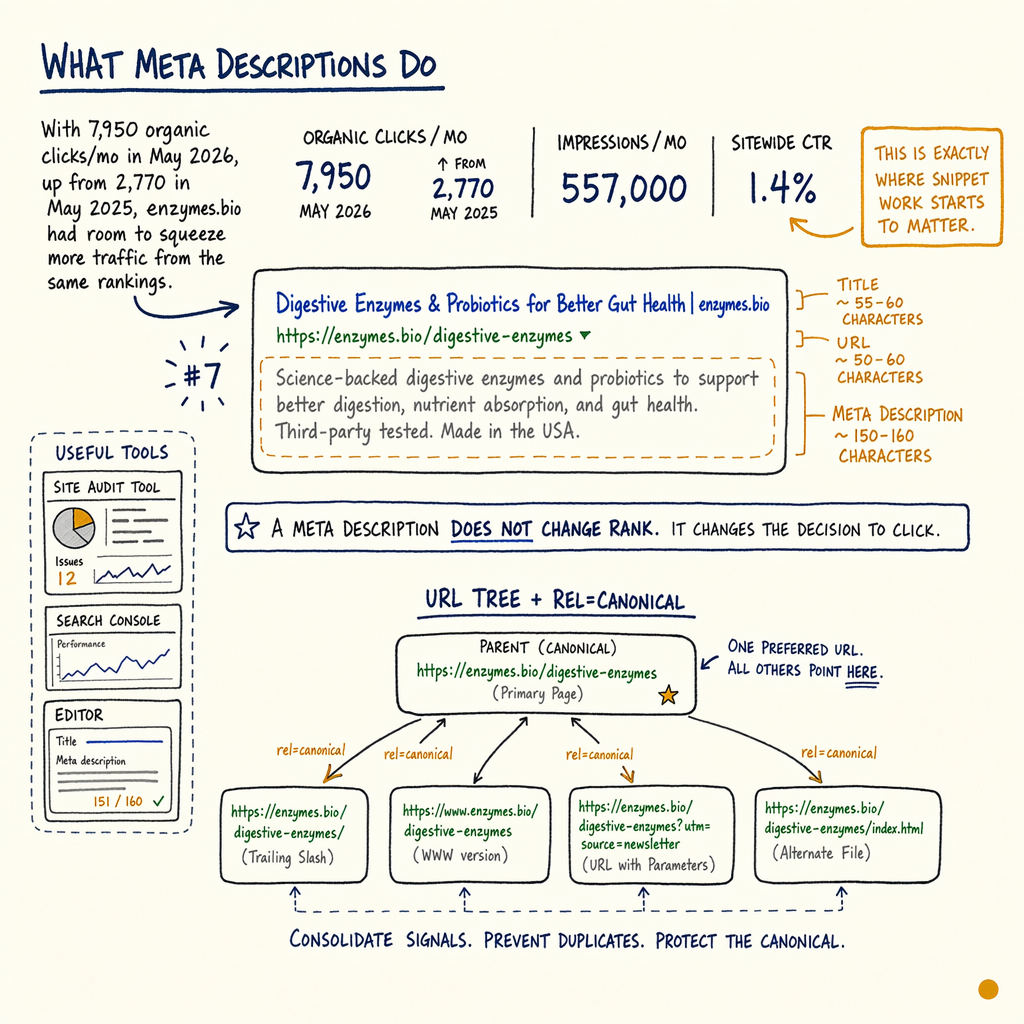
With 7,950 organic clicks/mo in May 2026, up from 2,770 in May 2025, enzymes.bio had room to squeeze more traffic from the same rankings. The site also had 557,000 impressions/mo and only 1.4% sitewide CTR, which is exactly where snippet work starts to matter.
A meta description does not change rank directly. It changes the probability that a searcher clicks your result instead of the one above or below it. That makes meta description seo a CTR problem, not a keyword-stuffing problem.
For pages sitting around position 8-15, the snippet often decides whether the result gets ignored or tested. If you want the framing around title tags too, pair this with title tag optimization and keep both elements aligned to the same intent.
Length targets that work
Desktop target: ~155 characters
That is the practical ceiling before snippets start truncating in many desktop SERPs. It is not a hard rule, but it is the safest range for meta description length when the message needs to survive intact.
Mobile target: ~120 characters
Mobile snippets are tighter, so the first clause has to carry the value. Put the outcome first, not the brand story.
Front-load the query language
If the page is about pricing, shipping, specs, or a definition, say that early. Searchers scan for terms they already typed, not clever copy.
Keep one page, one promise
If the page sells 12 things, the snippet usually sounds like none of them. A focused description makes the result easier to parse.
When Google rewrites snippets
Google rewrites meta descriptions when the provided text is too vague, too repetitive, or not aligned with the query. That is normal. It is not a penalty.
A rewrite usually means the page has multiple strong query clusters, but the snippet does not cover the one Google thinks is most relevant. The fix is rarely “add more keywords.” It is usually tighter intent matching, cleaner headings, and better on-page topic coverage.
This is why Performance › Search results matters more than opinion. Compare pages with strong impressions but weak CTR, then inspect the actual query set. If the snippet is generic and the query is specific, the rewrite is predictable.
Write for search intent
Start with the user task, not the page format. A good description answers one of four things: what it is, who it is for, what it costs, or why it is different.
A useful pattern is:
primary phrase + proof point + next step
Example: Meta description best practices for higher CTR. Write 120-155 chars, match intent, and reduce rewrites.
That formula works because it is specific, scannable, and easy for Google to reuse. It also keeps the description from drifting into title-tag territory or URL language that belongs elsewhere in the snippet stack, like URL structure best practices.
CTR fixes that matter
- ✓
Write a unique meta description for every indexable page with meaningful search demand.
- ✓
Keep the first 120 characters complete on mobile.
- ✓
Put the primary keyword near the front if it reads naturally.
- ✓
Use one concrete benefit, one proof point, and one action.
- ✓
Do not repeat the title tag line-for-line.
- ✓
Do not stuff brand names, dates, or filler words into every page.
- ✓
Check
Performance › Search resultsfor pages with high impressions and low CTR. - ✓
Compare snippet wording against the page's H1, intro, and top headings.
- ✓
Use
Indexing › Pagesto avoid optimizing noindex, canonicalized, or duplicate URLs.
Snippet template
<meta name="description" content="Meta description best practices for higher CTR. Write 120-155 chars, match intent, and reduce rewrites.">Audit workflow in GSC
Start in Performance › Search results. Export pages with more than 1,000 impressions and CTR below the site median. On enzymes.bio, the sitewide CTR was 1.4%, so even a small lift on high-impression pages can add meaningful clicks.
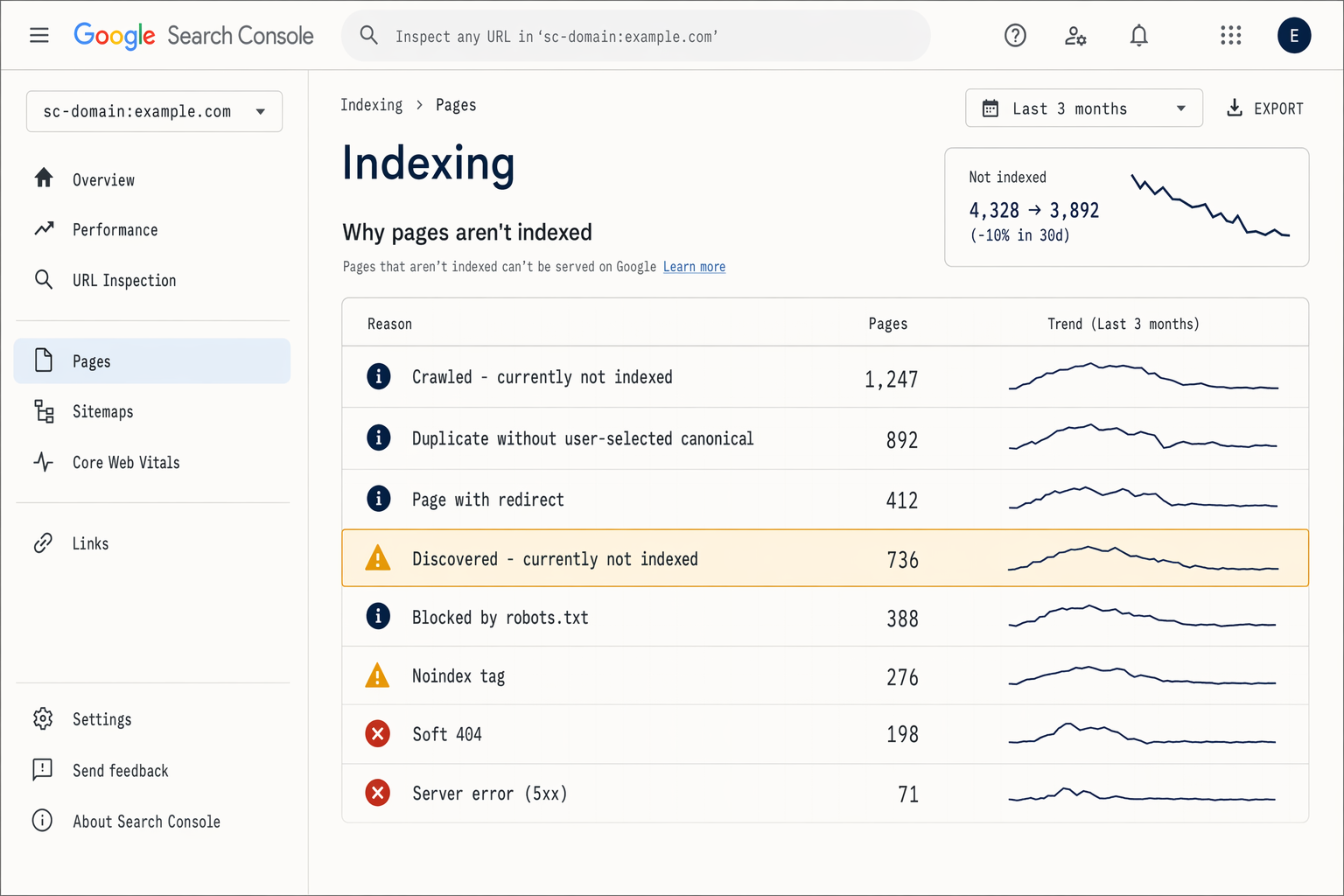
Next, confirm indexation in Indexing › Pages. There were 16,100 indexed pages and 591,000 not indexed pages, so the first question is not “what should I rewrite?” It is “which pages actually matter enough to deserve a snippet pass?”
Then check Links › External links and Settings › Crawl stats for context. With 0 external backlinks, the site’s rate-limiter is not authority dilution. It is snippet performance, internal discovery, and query alignment. If the page also needs CTR triage beyond the meta tag, the follow-up is improve CTR from search results.
Meta description vs title tag
| Field | Meta description | Title tag |
|---|---|---|
Primary job | Improve CTR with supporting copy | Set the page topic and earn the click |
Length target | About 120-155 chars | About 580px desktop equivalent |
Rewrite risk | High if generic or mismatched | Medium if duplicated or truncated |
Ranking impact | Indirect only | Indirect, via relevance and CTR |
Best use | Query intent and proof points | Core keyword and page promise |
DevTools check
document.querySelector('meta[name="description"]')?.content;
// Compare it with the title, H1, and first paragraph.
// If the snippet is generic, rewrite the copy before changing anything else.
Common questions
Do meta descriptions help rankings?
Not directly. They help CTR, which can improve traffic from the same rank. That is why writing meta descriptions is a search-performance task, not a ranking-factor hack.
What is the best meta description length?
Aim for about 120-155 characters. Use the first 120 chars to survive mobile, then keep the full line useful on desktop.
Why does Google rewrite my description?
Usually because the query needs different wording than your snippet provides. The fix is better intent coverage, not keyword repetition.
How do I improve meta description CTR?
Use a unique value proposition, mirror the query language, and make the promise specific enough to stand out in Performance › Search results.
Should every page have a custom description?
Not every page. Prioritize indexable pages with impressions, sales intent, or informational demand. Low-value URLs can stay default until they matter.