Free vs Paid SEO Audit: What You Actually Get
A free SEO audit can flag obvious issues fast, but it usually stops at symptoms. A paid SEO audit ties `Indexing › Pages`, `Performance › Search results`, and `Links › External links` together to explain why growth is stuck.
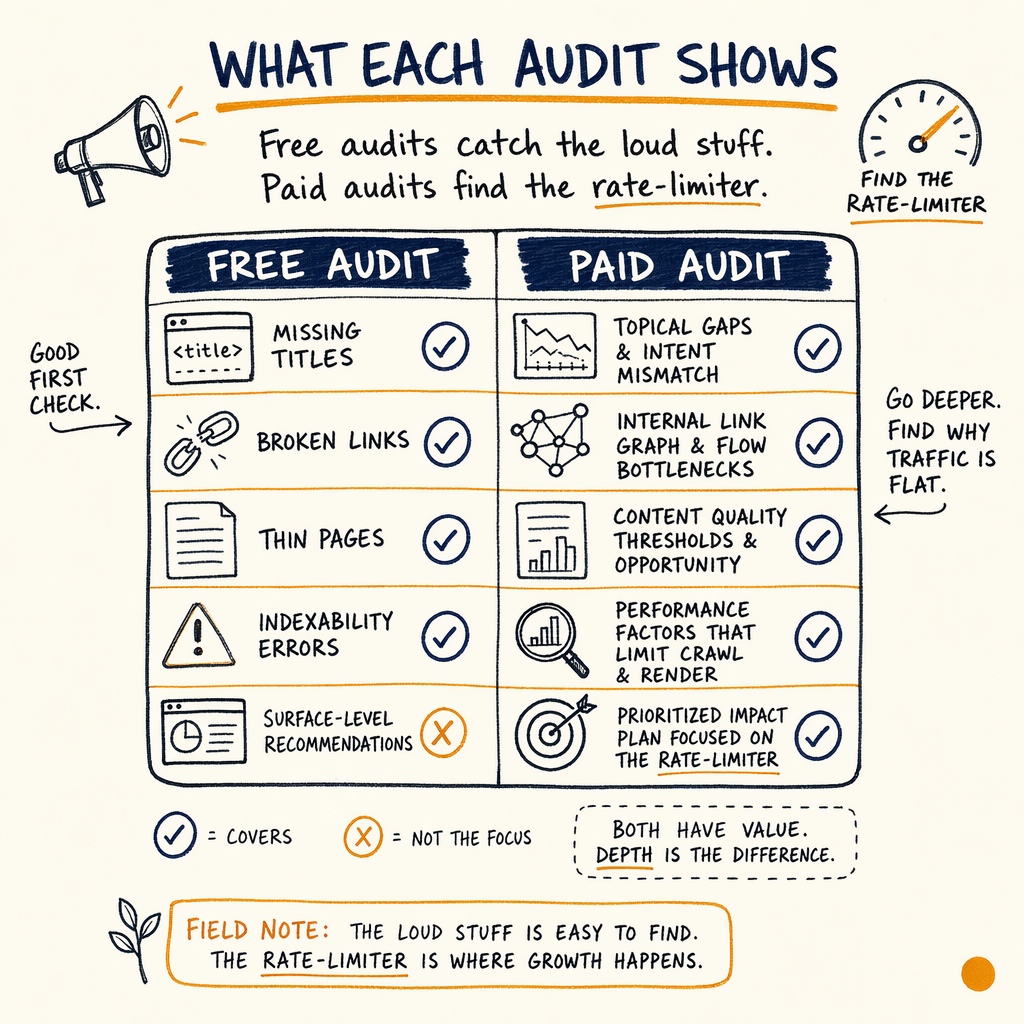
What each audit shows
A free SEO audit usually catches the loud stuff: missing titles, broken links, thin pages, and a few indexability errors. That is useful, but it is not the same thing as finding the rate-limiter.
A paid SEO audit goes deeper into the data that explains why traffic is flat. On an enzmes.bio-style ecommerce site, the meaningful signals were 7,950 organic clicks/mo in May 2026, 557,000 impressions/mo, 1.4% sitewide CTR, and average position 12.4 overall / 11.8 in May 2026. That mix says the site has demand, but too many queries sit just outside page one.
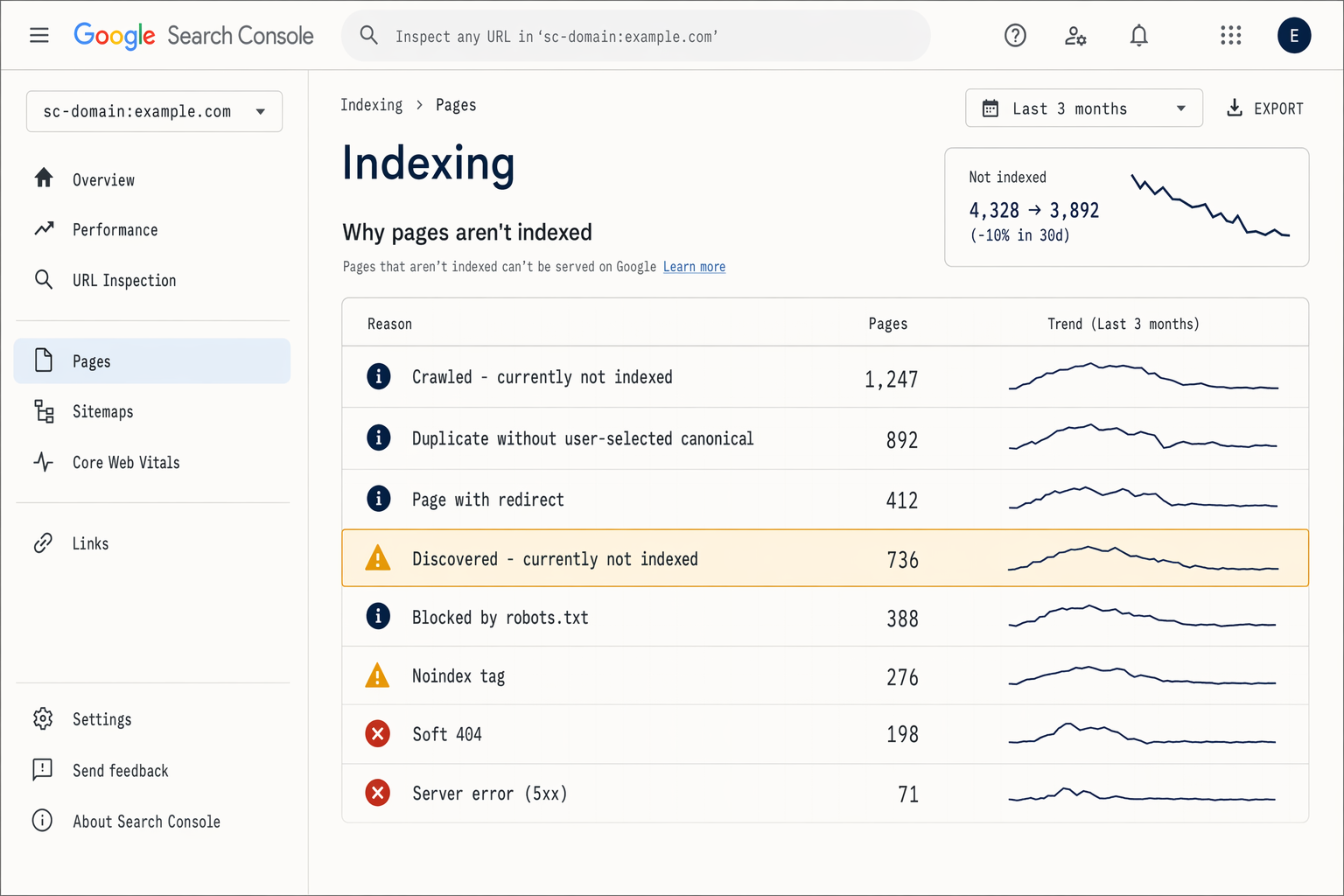
The real bottleneck was not content volume. It was 16,100 indexed pages, 591,000 NOT indexed, and 0 external backlinks. A free audit can point at a few page-level issues. A paid audit can connect those numbers to crawl budget, internal linking, template quality, and authority gaps.
Side-by-side comparison
| Field | Free SEO audit | Paid SEO audit |
|---|---|---|
Primary output | Checklist of obvious issues | Prioritised diagnosis with root causes |
Data source | Surface scan, limited samples | GSC-first, plus crawl logs, templates, and manual review |
Indexation view | A few URLs and error counts |
|
Performance view | Generic keyword position summary |
|
Authority view | Usually absent |
|
Core Web Vitals | Often a snapshot |
|
Outcome | You know what looks broken | You know what to fix first and why |
What free audits miss
Query-level intent mismatch
A free SEO audit may say a page ranks, but not that it ranks for the wrong query set. In GSC, you can see pages with 500+ impressions and a 1.4% CTR because the snippet misses intent, not because the page is absent.
Template-level problems
One bad template can affect thousands of URLs. Free tools usually inspect samples. Paid audits test patterns across product pages, category pages, faceted URLs, and translated variants.
Crawl waste
When 591,000 NOT indexed pages exist next to 16,100 indexed pages, the question is not just 'why are pages excluded?'. It is 'which URLs deserve crawl attention, and which are noise?'.
Authority starvation
If Links › External links shows 0 external backlinks, the issue is not a title tag. It is authority. Free audits rarely explain whether content, link acquisition, or internal routing should be fixed first.
What a paid audit looks like
{
  "gsc": {
    "performance_search_results": {
      "clicks": 7950,
      "impressions": 557000,
      "ctr": 0.014,
      "avg_position": 12.4
    },
    "indexing_pages": {
      "indexed": 16100,
      "not_indexed": 591000
    },
    "links_external_links": {
      "external_backlinks": 0
    }
  },
  "audit_output": [
    "top queries by opportunity",
    "page clusters with CTR loss",
    "indexation waste by template",
    "internal link fixes by priority",
    "launch-safe implementation list"
  ]
}
What paid audits include
A paid audit is not just a bigger checklist. It is a structured read on the site’s constraints, usually delivered as a Notion doc with evidence, screenshots, and a ranked fix list.
The useful parts are specific: Indexing › Pages for exclusion patterns, Indexing › Sitemaps for submission quality, Experience › Core Web Vitals for template performance, and Enhancements › Breadcrumbs, Enhancements › Product snippets, and Enhancements › FAQ for structured data coverage.
For a site like enzymes.bio, the work is not to admire the traffic. It is to explain why 943 orders to date and $240,809 lifetime revenue still leave obvious SEO headroom. At $255 AOV, even small gains in non-brand visibility can matter fast. That is where a paid audit pays for itself.
How the audit is done
- 01
Pull GSC first
Start with
Performance › Search results,Indexing › Pages,Indexing › Sitemaps,Links › External links, andSettings › Crawl stats. That shows demand, indexation, authority, and crawl capacity before any tool noise. - 02
Group by template
Cluster URLs into templates: product, collection, guide, localization, and translated pages. A single template bug can explain hundreds or thousands of low-CTR or excluded URLs.
- 03
Map the blockers
Separate symptom from cause. A
noindextag is a symptom if it is intentional. It is a blocker if it was inherited from staging, a filter, or a bad theme setting. - 04
Rank fixes by upside
Prioritise pages and templates with the highest traffic, the lowest CTR, and the clearest fix path. That is how a paid SEO audit turns into implementation work instead of a PDF that sits in a folder.
Cost versus value
| Question | Free SEO audit | Paid SEO audit |
|---|---|---|
What is the SEO audit cost? | Usually free, but shallow | Paid upfront, but tied to scope and time |
Is SEO audit worth it? | Yes for spotting obvious errors | Yes when traffic, crawl, or conversion stagnate |
Best use case | New site sanity check | Growth site with stubborn ceilings |
Expected return | Avoids preventable mistakes | Finds compounding fixes with measurable upside |
Sample audit evidence
curl -s 'https://searchconsole.googleapis.com/webmasters/v3/sites/sc-domain%3Aexample.com/searchAnalytics/query' \
  -H 'Authorization: Bearer $TOKEN' \
  -H 'Content-Type: application/json' \
  --data '{
    "startDate": "2026-05-01",
    "endDate": "2026-05-31",
    "dimensions": ["query", "page"],
    "rowLimit": 10
  }'

# Then compare against:
# `Indexing › Pages`
# `Indexing › Sitemaps`
# `Experience › Core Web Vitals`
# `Links › External links`
FAQ
What is the difference between a free vs paid SEO audit?
A free audit usually flags obvious technical issues. A paid audit connects GSC, indexation, crawl stats, and templates to find the root cause behind missed clicks, wasted crawl, or poor CTR.
When is a free SEO audit enough?
It is enough when you need a quick sanity check, a launch checklist, or a rough scan of obvious errors. If the site is small and traffic is not changing, free may be fine.
When is a paid SEO audit worth it?
It is worth it when the site has traffic but weak growth, when many URLs are excluded, or when Performance › Search results shows demand but rankings stall around positions 8-20.
What should a paid audit include?
At minimum: GSC review, template analysis, Indexing › Pages, Indexing › Sitemaps, Experience › Core Web Vitals, Links › External links, and a prioritised fix list.
How do I judge SEO audit cost?
Compare the fee to the likely upside. If a site has 7,950 organic clicks/mo, 557,000 impressions/mo, and 0 external backlinks, even small lifts in CTR or rankings can pay back quickly.
Can a free audit replace consulting?
No. A free audit can replace some basic diagnosis. It does not replace decision-making, trade-off analysis, or implementation guidance across templates and content.
When to pick which
Pick a free SEO audit when you need a quick scan, a launch preflight, or a first-pass checklist you can run yourself. It is the right fit for small sites, low-risk changes, and teams that only need obvious problems surfaced.
Pick a paid SEO audit when the site has data but no momentum. That includes sites with lots of impressions, middling average positions, low CTR, or strange indexation patterns. If Search results shows demand and Pages shows bloat, the issue is not the absence of SEO activity. It is misallocation.
For comparison context, pair this page with DIY vs hired SEO consultant, in-house vs agency SEO, and the technical SEO audit service. If you want the practical checklist version, use the technical SEO checklist PDF.