XML sitemaps best practices: structure, splitting, submission
7,950 organic clicks/mo, 557,000 impressions/mo, and 16,100 indexed pages only matter if Google can crawl the right URLs. XML sitemaps are a control file, not a ranking trick.
What sitemaps should do
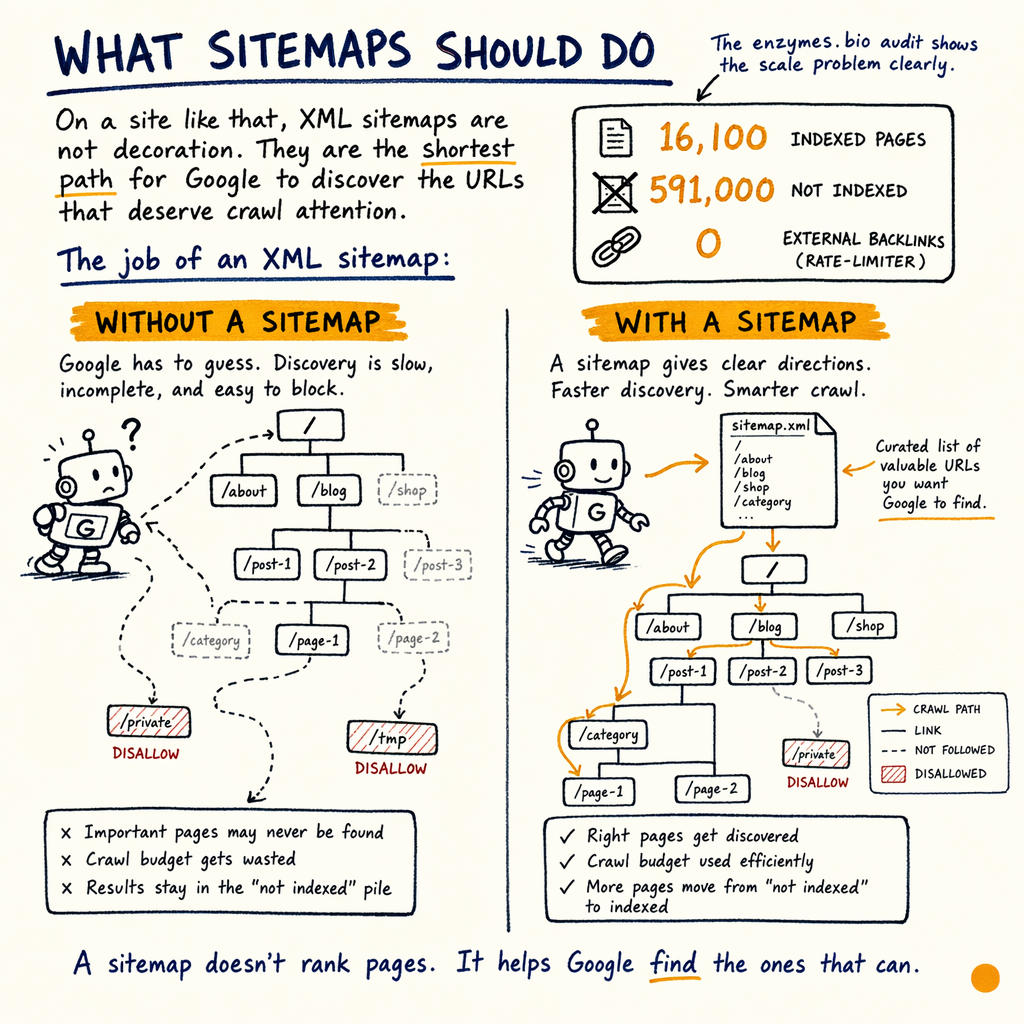
The enzymes.bio audit shows the scale problem clearly: 16,100 indexed pages, 591,000 not indexed, and 0 external backlinks as the rate-limiter. On a site like that, XML sitemaps are not decoration. They are the shortest path for Google to discover the URLs that deserve crawl attention.
The job of an xml sitemap is simple: give Google a clean, canonical list of indexable URLs with correct metadata. It should not contain redirects, 404s, parameter junk, non-canonical duplicates, or pages blocked by robots.txt. If the sitemap is noisy, Google wastes fetches and your crawl budget gets diluted across bad candidates.
Use the Indexing › Pages report to compare submitted URLs against indexed URLs. Then check Settings › Crawl stats for whether fetch volume is going to useful paths or spinning on repeat fetches and redirect chains. On sites with thin link graphs, the sitemap often decides which pages get discovered first.
For setup and rules around crawling controls, pair this page with robots.txt best practices and crawl budget optimization.
Core sitemap rules
Only canonical 200 URLs
List URLs that return 200 OK, are indexable, and are the preferred canonical version. Exclude 301, 302, 404, 410, and anything blocked from indexing.
Keep `lastmod` truthful
Use sitemap lastmod only when the underlying content changed. Fake timestamps teach Google to ignore the field. Honest dates help prioritize recrawls.
Split by purpose
Separate content types when scale grows: products, categories, articles, images, videos, and hreflang-bearing URLs. That makes debugging faster and keeps error rates visible.
Watch file size limits
A single sitemap file should stay under 50,000 URLs and under 50 MB uncompressed. Use a sitemap index to bundle child sitemaps once you get near those limits.
Treat submission as a signal
A sitemap submission in Indexing › Sitemaps is not a guarantee. It just says Google received the file. You still need clean URLs, stable responses, and internal links.
Prefer stable fetch paths
If the sitemap is served through a Cloudflare worker, make sure it returns 200, Content-Type: application/xml, and no accidental compression or HTML fallback.
Split by URL type
The best xml sitemap best practices setup is usually multiple narrow files, not one giant dump. Split by template or content class so you can spot which bucket goes bad first.
Typical split points:
- Product detail pages
- Category or collection pages
- Blog or editorial pages
- Image sitemap entries
- Video sitemap entries
- Alternate-language URLs generated through TranslatePress
Indexing › Pages becomes harder to interpret.
For a multilingual site, the audit should also compare language variant counts against actual index coverage. With 35 languages via TranslatePress, one broken sitemap rule can multiply into thousands of missed alternates. If you include hreflang pairs in sitemaps, every referenced URL should return 200 and be canonical in its own language variant.
Split patterns that work
| Field | Good pattern | Bad pattern |
|---|---|---|
File grouping | One file per template or language group | One file with every URL type mixed together |
Size control | Stays well below 50,000 URLs | Hits the ceiling and gets rolled over late |
Debugging | Clear error isolation in | Every warning applies to the whole site |
Recrawl priority | Fresh content gets its own child sitemap | Old and new URLs share the same update cadence |
Multilingual handling | Language-specific child sitemaps plus hreflang rules | Translated URLs buried in a generic file |
Build a sitemap index
A sitemap index is the clean way to scale past a single file. Think of it as a manifest that points to child sitemaps. Google can fetch the index, then fan out to only the files that changed.
A simple pattern looks like this:
sitemap-index.xmlsitemap-products.xmlsitemap-categories.xmlsitemap-articles.xmlsitemap-images.xmlsitemap-en.xml,sitemap-de.xml, and so on if language separation is useful
For large sites, keep an eye on Settings › Crawl stats. If Google is hitting the index often but not the child files, the issue is often not discovery. It is fetch quality, redirects, or server response instability.
Sample sitemap index
<sitemapindex xmlns="http://www.sitemaps.org/schemas/sitemap/0.9">
  <sitemap>
    <loc>https://example.com/sitemaps/sitemap-products.xml</loc>
    <lastmod>2026-05-21</lastmod>
  </sitemap>
  <sitemap>
    <loc>https://example.com/sitemaps/sitemap-articles.xml</loc>
    <lastmod>2026-05-21</lastmod>
  </sitemap>
  <sitemap>
    <loc>https://example.com/sitemaps/sitemap-images.xml</loc>
    <lastmod>2026-05-21</lastmod>
  </sitemap>
</sitemapindex>
Make lastmod honest
- 01
Map real change events
Set
lastmodfrom actual publish, update, stock, or canonical changes. Do not refresh timestamps on every build if the page body stayed the same. - 02
Use UTC or fixed format
Keep the date format consistent. If your system stores UTC timestamps, convert them cleanly before writing the XML.
- 03
Exclude false churn
Ignore cosmetic edits like UTM changes, CMS metadata noise, or template-only tweaks unless they change the HTML Google sees.
- 04
Validate against crawl logs
Compare recent
lastmodvalues with server log hits. If a page claims constant freshness but is never re-fetched, the signal is probably being discounted.
Add image and hreflang
Use image and language extensions only when they add real discovery value. The point is not to stuff more XML into the file. The point is to surface content that is hard to discover through links alone.
For image-heavy pages, the image sitemap can help Google associate product imagery with the main URL. For multilingual sites, hreflang in sitemaps can reduce ambiguity, especially when translated versions are buried under JavaScript or locale routing.
The practical rule is simple: every URL listed in the sitemap should be indexable, canonical, and reachable without soft failures. If a translated page returns 200 but canonicalizes to the English version, do not include it as a stand-alone index target. If a media URL returns 302 to a CDN tokenized path, fix the source URL first.
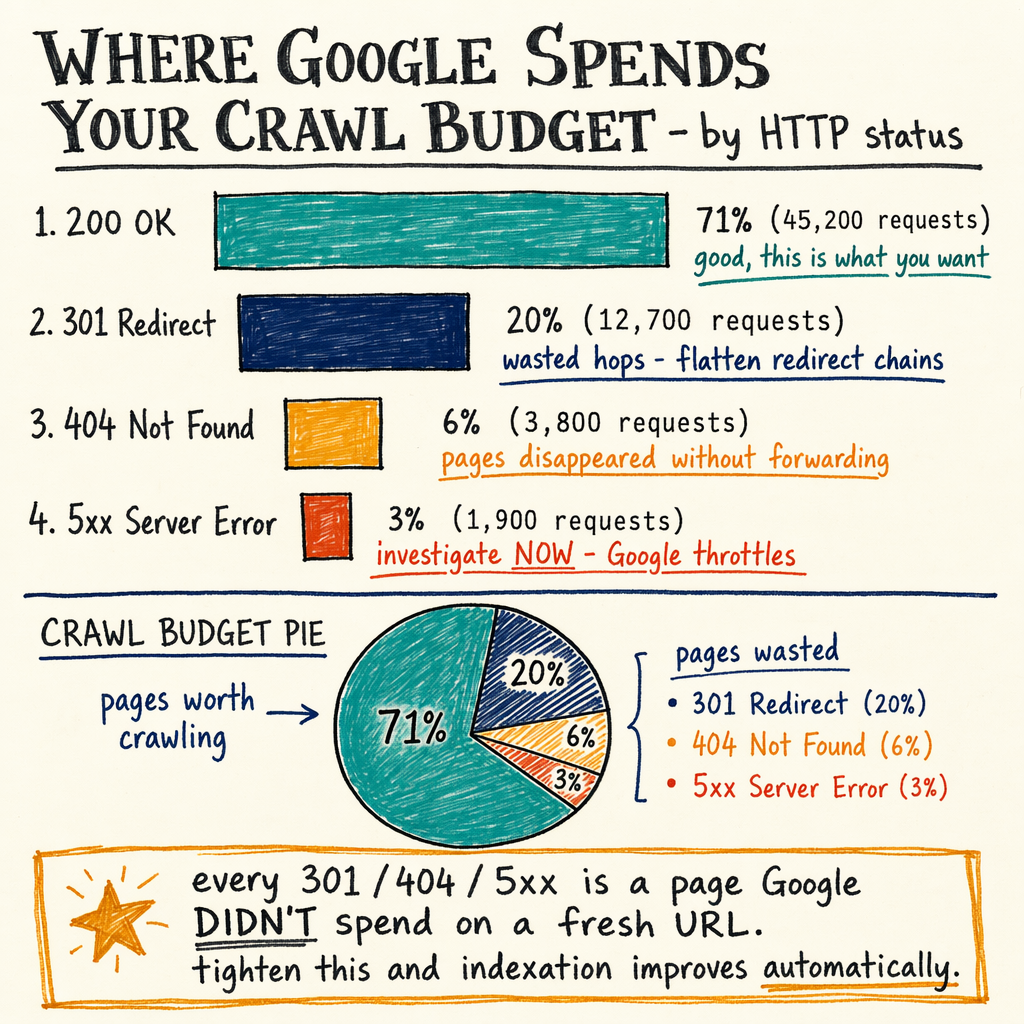
Reference the image sitemap only for the assets that matter. For a site with heavy product content, this crawl-budget diagram is a better guide than a long abstract explanation: every extra URL in the sitemap is a fetch candidate, so keep the set tight.
Validate with curl
curl -I https://example.com/sitemaps/sitemap-index.xml
curl -s https://example.com/sitemaps/sitemap-products.xml | head
curl -I https://example.com/sitemaps/sitemap-products.xml | grep -E 'HTTP/|content-type|cache-control'

# Check for redirect chains and bad status codes
curl -I -L https://example.com/sitemaps/sitemap-articles.xml
Submit and validate
Open Indexing › Sitemaps and submit the index file, not every child file unless there is a specific reason. Google can discover child sitemaps through the index. Manual submission should be reserved for debugging or staged rollout.
Then validate three things:
- The submitted URL returns
200, not301or302 - The file is XML, not an HTML error page from a WAF or CDN rule
- The counts in
Indexing › Sitemapsroughly match what your CMS generated
Could not fetch, move to fix sitemap could not fetch. That error usually comes from blocking, redirects, malformed XML, or intermittent 5xx responses. If you see 429, the worker or origin is rate limiting bots too aggressively.
The Performance › Search results report is the output check. If submission rises but impressions stay flat, the sitemap is not the bottleneck. The problem is usually crawl demand, internal links, or indexing quality.
Validation checklist
- ✓
Sitemap URLs return
200 OKwithContent-Type: application/xml. - ✓
No sitemap URL redirects with
301or302. - ✓
No listed URL returns
404,410,429, or5xx. - ✓
robots.txtdoes not block the sitemap or the URLs inside it. - ✓
Every listed page is canonical and indexable.
- ✓
lastmodchanges only when page content changes. - ✓
The sitemap stays under 50,000 URLs and 50 MB uncompressed.
- ✓
Child sitemaps are grouped by template, language, or file type.
- ✓
The
Indexing › Sitemapsreport shows the expected submitted count. - ✓
Server logs show Googlebot fetching the URLs you actually want indexed.
Read crawl signals
Sitemaps and crawl stats should be read together. If Settings › Crawl stats shows repeated hits to the same low-value paths, the sitemap may be too broad or the site may be leaking crawl demand through internal links.
Server logs are where the truth lives. Look for Googlebot request patterns across 200, 301, 304, 404, 410, 429, and 5xx. Good sitemap hygiene should push more requests toward stable 200 URLs and fewer toward redirects and errors. A high 304 rate can be fine for unchanged content, but if 304 dominates while fresh pages sit unvisited, Google may not be seeing enough value in the URL set.
This is where a Cloudflare worker pattern can help. A worker can normalize trailing slashes, block accidental XML corruption, and serve the current sitemap index from edge cache while still allowing rapid regeneration on deploy. Just make sure the worker does not rewrite canonical hostnames or mask origin failures that should be visible in logs.
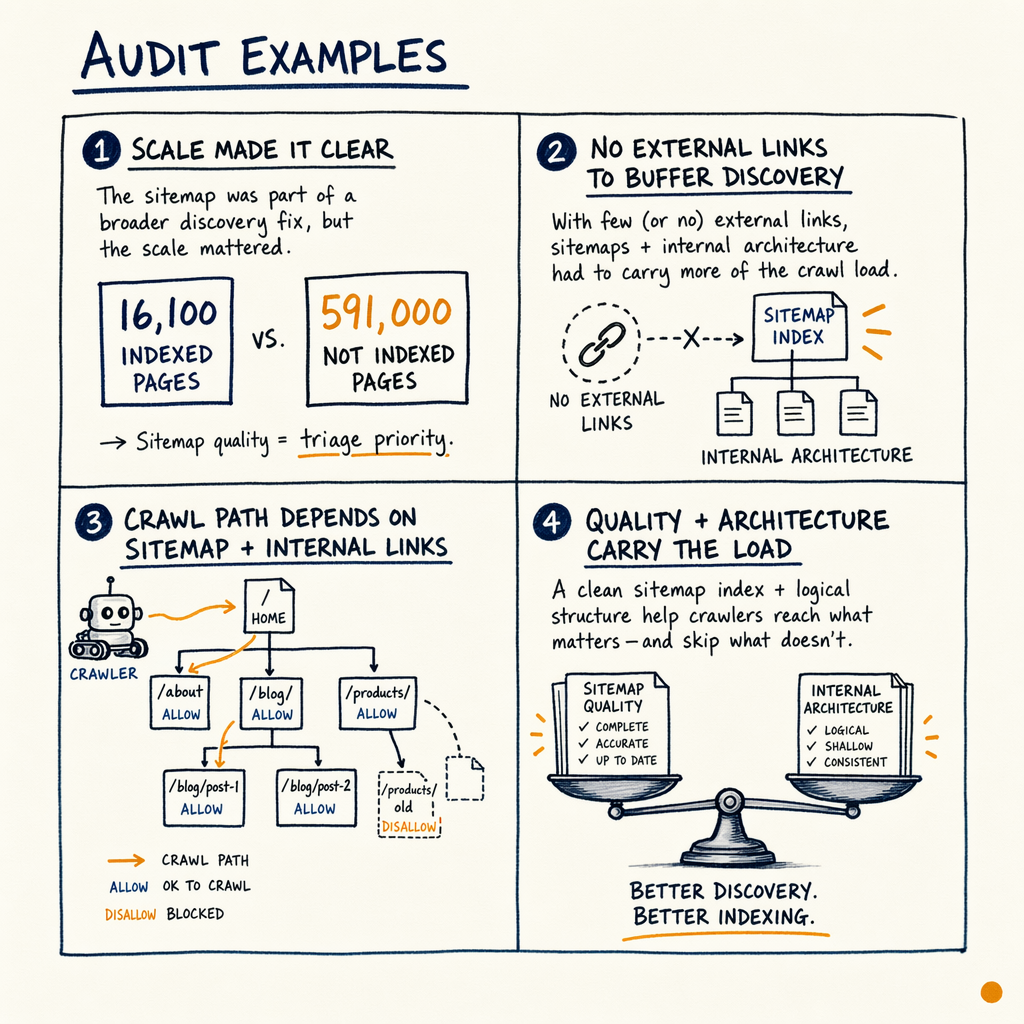
If the site has weak external authority, crawl efficiency matters even more. With 0 external backlinks, discovery depends heavily on internal architecture and sitemap accuracy. That is the exact kind of situation where a technical audit pays for itself quickly. If you want a full crawl-path review, see technical SEO audit.
Common questions
How many URLs should one sitemap contain?
Keep each file under 50,000 URLs and under 50 MB uncompressed. Split earlier if the site is large enough that debugging one bucket would be painful.
Should I submit every child sitemap in GSC?
Usually no. Submit the sitemap index in Indexing › Sitemaps. Google can discover the children from there, and the index is easier to maintain.
Does `lastmod` help rankings?
lastmod is not a ranking signal by itself. It is a freshness hint. It helps Google decide what to recrawl when the date is truthful and stable.
What status code should sitemap files return?
They should return 200 OK. A sitemap file that returns 301, 302, 404, 429, or 5xx is a fetch problem, not a discovery asset.
Should blocked URLs be in the sitemap?
No. If robots.txt blocks a URL or the page is intentionally non-indexable, do not list it. A sitemap should describe indexable targets only.
When does a dynamic sitemap make sense?
When URLs change often or the site is too large for manual maintenance. The key is deterministic output and clean validation on every build or deploy.
Fix common failures
Most sitemap failures are boring and fixable. The common ones are malformed XML, stale URLs, bad gzip handling, redirects from old paths, and XML files that get replaced by HTML error pages at the edge.
If you need to debug quickly, use this order:
- Confirm the exact sitemap URL in
Indexing › Sitemaps. - Fetch it with
curl -Iand confirm200. - Open the raw XML and check for entity escaping problems.
- Verify that every
<loc>is canonical and returns200. - Compare the submitted counts with
Indexing › Pages. - Inspect
Settings › Crawl statsfor spikes in404,429, or5xx.
For a broader interpretation of discovery, indexing, and report reading, keep Google Search Console guide open while you work.
DevTools fetch check
fetch('/sitemaps/sitemap-index.xml', { method: 'GET' })
  .then(async (res) => {
    console.log('status', res.status)
    console.log('content-type', res.headers.get('content-type'))
    const text = await res.text()
    console.log(text.slice(0, 200))
  })
  .catch(console.error)
Audit examples
The sitemap was part of a broader discovery fix, but the scale mattered: 16,100 indexed pages against 591,000 not indexed made sitemap quality a triage priority.
With no external links to buffer poor discovery, the sitemap index and internal architecture had to carry more of the crawl load. That made stale lastmod values and redirect chains especially costly.
The site had real commercial value, so the audit focused on URLs that could convert. A clean sitemap bucket for commercial pages was more useful than a single broad file.